The Greatest 33 – 2015 Post-500 Edition (aka Rambling Indy 500 nerdery alert)


Without deigning to delve into Detroit’s drenched driving debacle, this week’s post will focus on the update to my Greatest 33, post-2015 Indy 500. If you recall the post prior to the race, I pondered how this might change depending on who won, lead laps, and finished in the top 5. Change it did.

After a few very minor tweaks to the formula prior to the 2015 Indy 500, I had reconciled the slight discrepancy in weight of winning versus the other statistics I use to rate the drivers. It had a very slight effect in that by increasing the value of a win and a pole by approximately 10%, relative to everything else, and decreased a top 5 finish by 20%, winning is as important a criteria as ever. Some drivers who’ve enjoyed more success in winning poles, received a slight upgrade, versus those who may have won but perhaps lead fewer laps, or managed a top 5 for example. 

As you may recall, I also have my own “Last Row Party” made famous by the Indianapolis Press Club Foundation members for the rather dubious honor of starting in the last row.  My last row is a specially designated place for the three best ever to have never won. Essentially, I have a Greatest 30, plus three with careers of significance, but lacking that final turn into victory lane.

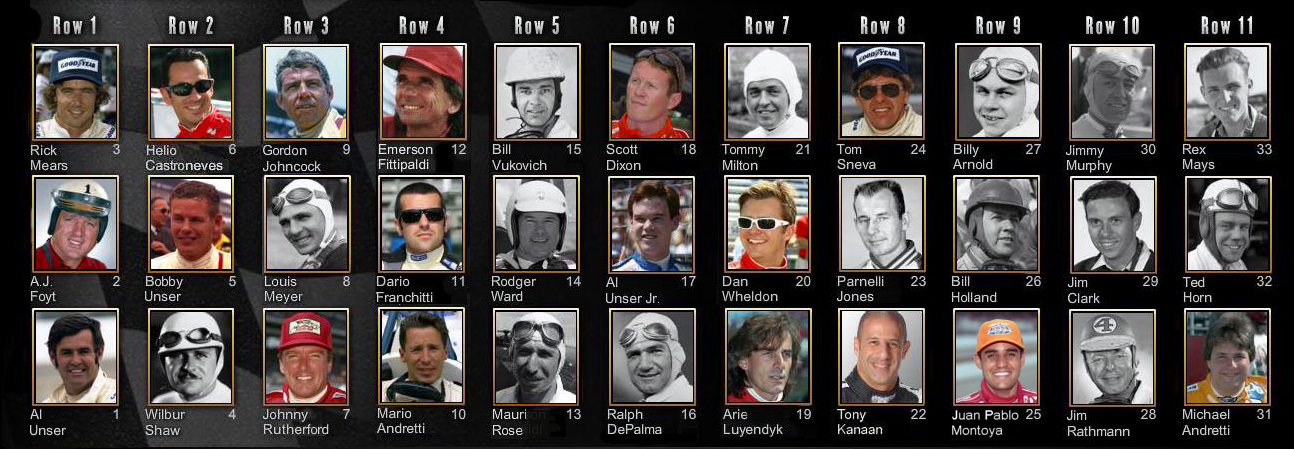
Found as the cover photo on @groundedeffects Twitter, here is my Greatest 33 following the 2015 Indy 500 results:


Here’s a closer look by groups of Rows…


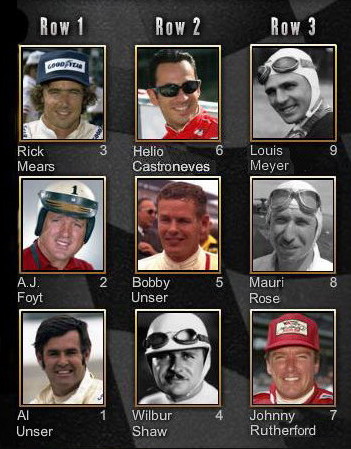
Rows 1 – 3: Unchanged due to Helio not adding a 4th win to his tally.

Rows 4 – 7: With the slight change in scoring Franchitti gains one spot over Fittipaldi by virtue of an additional win, but still so very close overall (4 points or 00.31%) . Bill Vukovich also gained a spot over DePalma and yet another difference so slight (11 points/01.16%) it’s almost a crime either gets the nod over the other. Scott Dixon won a pole, led many laps and gained another top 5 finish. If Dixon had won, we’d be looking at him moving into Row 4 between Mario and Dario. Aside from Montoya, ‘the Iceman’ made the most gains in places (4) from inside Row 8 to outside Row 6.


Rows 8 – 10: Dixon’s upgrade sent Parnelli back into Row 8 and in another quirk of numbers, he also lost a spot to Kanaan who leads by a nearly infinitesimal 3 points (or 00.32%) difference. Assuming Kanaan races in another 500, he will likely surpass Milton, and move out of this group into Row 7. Landing in this group from outside the Greatest 33 is the biggest mover overall and this year’s winner, Juan Pablo Montoya. From a non-descript spot among single-winners, JPM vaults up 21 spots into inside Row 9. Jim Clark also loses 3 very closely contested spots with Bill Holland, Billy Arnold, and Jim Rathmann gaining a spot by virtue of the formula modification. 


Montoya’s promotion also relegates another driver from the list. Did you notice who it was? Unfortunately for his cadre of fans, the bespectacled and thickly-mustachioed Bobby Rahal drops from the list into the great beyond. Perhaps Rahal the Younger will avenge his family’s name and appear once or twice himself. 


Row 11: Unchanged although it is worthy to note that Marco Andretti is the highest rated active, non-winning driver currently. Barring a win, Marco could very likely unseat Rex Mays with just two or three more top 5 finishes or leading another 140 laps. Would two Andrettis cruelly book-ending the futility of the final row be something the racing gods intended?


And my current criteria for selecting these drivers:


Several active drivers were added to my list as they all stand a chance of being part of the conversation should they win a 500. Among the remaining active drivers, Hunter-Reay and Marco are the two leading active candidates who could possibly bump their way into the Greatest 33 grid, the rest will need more than a win to get close to making the top 30.

It’s also noteworthy that at this point, two wins basically solidifies you into the Greatest 33, putting Hunter-Reay in the “first alternate” position. One-timers Mario, DePalma, Dixon, Kanaan, Parnelli, and Sneva all seem to be quite solidly in for the time being. There are more single-win drivers (48) that of all other multiples combined (19),a nd only 10 have made the list, so to be a single-winner and make the Greatest 33, requires an outstanding career. 

Let me know what you think about the latest legacy of The Greatest 33..


We’ve Been Here Before (aka Existential Ramblings)

It’s Indianapolis.

It’s May.

It’s the Indianapolis 500 Mile Race and all that accompanies it.

Speed. Danger. Thrills. Drama.

This Sunday will be my 28th Indy 500.

In light of the recent uproar regarding the on-track incidents of the past week, (largely from those voices with a marginal or myopic understanding at best of the history of this event), it should also be noted that those who can frame last week from a larger, more historic viewpoint, see this as nothing terribly unusual nor panic-inducing as some in the broadcast media might.

The above was my previous post idea in process for today and I’ve since changed my thought process in light of the particularly graphic description by this Racer article that was released today describing the injuries sustained and the subsequent life-saving treatment by the Holmatro Safety Crew of James Hinchcliffe yesterday. 

In times like these when circumstances violently remind us that our racing heroes are in fact mortal, my thoughts seem gravitate to one inescapable truth of auto racing:

No matter how dissonant our love of the thrill, and our dislike for the inherent danger required at the highest levels, auto-racing, and more specifically, Indycar racing, is a brutal sport. Nowhere is it more glorious or more brutal than at its most hallowed ground – The Indianapolis Motor Speedway.

A curiosity surrounding the spectre of death seems to be an integral part of the human psyche. There are many forms of auto-racing but it seems at the grandest of “Cathedrals of Speed”, Indycars racing at Indy have a way of most-markedly forcing us to confront this dark part of our psyche. 

Speed, thrills, crashes, injury, and death represent the long dark thread woven into the otherwise colorful and vibrant fabric of auto-racing. That long dark thread also serves to remind us all that despite machinations otherwise, there is a delicate fragility to life and shockingly so when juxtaposed against those brave ones who inspire the rest of us by risking life and limb. Their risk traded for mere glory and riches. 

I believe I understand the need or near-fixation of many to participate in that arena, but let’s also not forget that they do it, ultimately, because we pay to watch them do it. 

James Hinchcliffe is another in a very long list of those who have exhibited the appropriate skills, weighed the consequences, and assumed the risks in trade for our money and adulation.

“Hinch” is now another in a very long list of those who also have traded sinew, tissue, blood, bone, mental faculties, and life essence in trade for our money and adulation.

Culpability begins at home. 

Culpability begins in the family car, the RV, the Bus, driving to the ol’ Speedway, wearing specially printed shirts and 51-weeks-pre-paid tickets in hand. 

We cannot, as willing witnesses to the immense inspirations of their glory, also selfishly turn a blind eye in their darkest of moments. Drivers, crews, families, and fans are all bonded by the acceptance of these non-negotiable terms.

After all these years, I think only in the last year or two have I reconciled my feelings of immense guilt and culpability when the awful things happen with the immense satisfaction and joy when things go so very right in this sport. 

This Sunday, in Speedway, Indiana, I’ll accept that I’m there to see something amazing and satisfying with the knowledge that I could also, at any point, in any turn, by any driver, see things go horribly wrong. I don’t revel in that thought, but I do accept it. Just as I am there to see amazing, so are the drivers there from a desire to produce it.

Perhaps that is why the reverence for this cathedral and those who’ve chosen to compete there grows in me with every passing year. I feel a sense of duty to return, and to toast with a drink, in celebration of the courage of these racers in their grand success and to exhibit proper reverence in their moments of pain.

May this Sunday be filled with celebration.


Where Amazing Happens / Alternate Realties

One of the most enjoyable parts of the Indy 500 is not only the amazing and rich history of the event, but knowing that each year is an opportunity to see something amazing. 


Some of the richest lore comes from events that seemed destined for a certain end if not for the intervention of fate’s final twist and newest Indy legend born.

I think of some of those events that nine times out of ten would turn out differently, more predictably, yet didn’t, forever changing the future course of the race itself.  Over the next few weeks, I’m going to offer some of the most influential twists of racing fate in Indy 500 history and offer some alternate histories:


1987 – Mario Is Slowing Down:
The 71st Running of the 500 should have been the most uninteresting of modern history. Dominating the entire month’s practice speeds through qualifying and even the Carb Day pit stop competition, Mario Andretti looked poised to finally shed the “Andretti Curse” and win his second Indy 500. Leading from the drop of the green flag, Mario led 170 of the first 177 laps of the race, losing the lead only briefly during pit cycles. On Lap 177, Mario was cruising to a seemingly easy victory when an electronic fueling malfunction occurred forcing Mario to the pits. His car never recovered and from there we know the rest, Roberto Guerrero assumes the lead after being over a full lap down to Mario, only to stall in the pits on the final stop allowing a further lap down Al Unser, Sr., to assume the lead.  ‘Big Al’ hangs on to win his fourth after being rideless just 13 days prior.

Now let’s engage some imaginative thought; just forget the history as it exists and travel down a new path…


Mario wins the 1987 Indy 500 in a runaway victory. He and Michael go on to finish 1st/2nd respectively in the points title for different teams. Newman/Haas, seeing the extreme value in having the two together, expands to include Michael for 1988, driving Lola/Chevrolets for 1988. Struggling initially, they hit their peak at the 1988 Indy 500 with Michael defeating Mario via a late-race restart and becoming the first (and only to date) Father-Son pair to finish 1-2 at Indy.

Kraco Racing (Michael’s previous team), starts the 1988 season with Al Unser behind the wheel and has predictably steady results due to the combination of the March chassis, Cosworth motor, and Big Al’s tempered hand on the wheel. Near the end of the 1988 season, Kraco Racing is absorbed by Rick Galles Racing forming yet another formidable father-son team combination with Al Jr. for 1989.  The Andretti-Unser “family feud” begins and runs through the 1992 season when Mario, Al Sr., AJ Foyt, and Rick Mears all retire.

These ‘Legends of the Brickyard’ leave a massive hole in the sport with their retirements – AJ with 4- 500 wins, Mario and Al Sr. each with 3, and Mears with 2.  Mario comes out of retirement for the 1993 Indy 500 and finishes second to Michael again.

Al Unser, Jr., never makes it to victory lane in 1992 and never utters those famous words, Emerson Fittipaldi never becomes reviled as he was for drinking orange juice in 1993. Andrettis go on to to place three different family faces on the Borg-Warner, totaling 6 wins, Mario 3, Michael 2, Marco 1.  


The Legacy of ‘The Greatest 33’

I am, perhaps, quite predictable. 

I can’t possibly know this, however, unless evidenced by others. 

For those that know me well, they register only faint surprise when I produce one of two sports-related anecdotes; one that employs use of comparative statistics, or one that reflects my nostalgic nature.

Today’s post is a little of both.

As a nostalgist, a willful tethering to the past is standard operating procedure for better or worse and when it comes to the subject of Indycars and the Indy 500, I am tethered thusly. So on a day like yesterday, that deep spring day when the cars begin their first ovoid circuits of The Track in May, I eagerly recall familiar places and things past from the greatest of all speedways. 

One such thing was a website that silently orbited the internet, maintaining its critical function for only a few years, until it was taken down, it’s original mission essentially complete. IMS produced an interesting site for the 100th Anniversary race in 2011 called The Greatest 33. While the site his since been taken down, it produced much fodder for Indy 500 fans and I also participated in assembling my own ‘Greatest 33’.

The process for doing the original was enjoyable and so I’ve been fairly diligent in maintaining a spreadsheet with the formula I used and data entered to make my selections (only active drivers with wins or with many years of experience need updating). Every year around the start of May, I open it again and review it for ‘accuracy’. In other words, I ponder whether I feel that the formula used is still fair and producing ‘accurate’ relative rankings. I’ve never been one to rely on totally subjective feelings and thoughts when considering something of this magnitude. Mine is perhaps quite the opposite. I rely first and foremost on the statistics of performance as this is my personal preference for assessing the Greatest 33.

One exception I made to the hardness of the numbers was a play on the “Last Row Party” made famous by the Indianapolis Press Club Foundation members for the rather dubious honor of starting in the last row.  My last row was to be made a specially designated place for the three best ever to have never won. Essentially, I have a Greatest 30, plus three with careers of significance, but lacking that final verse of the turn into victory lane.

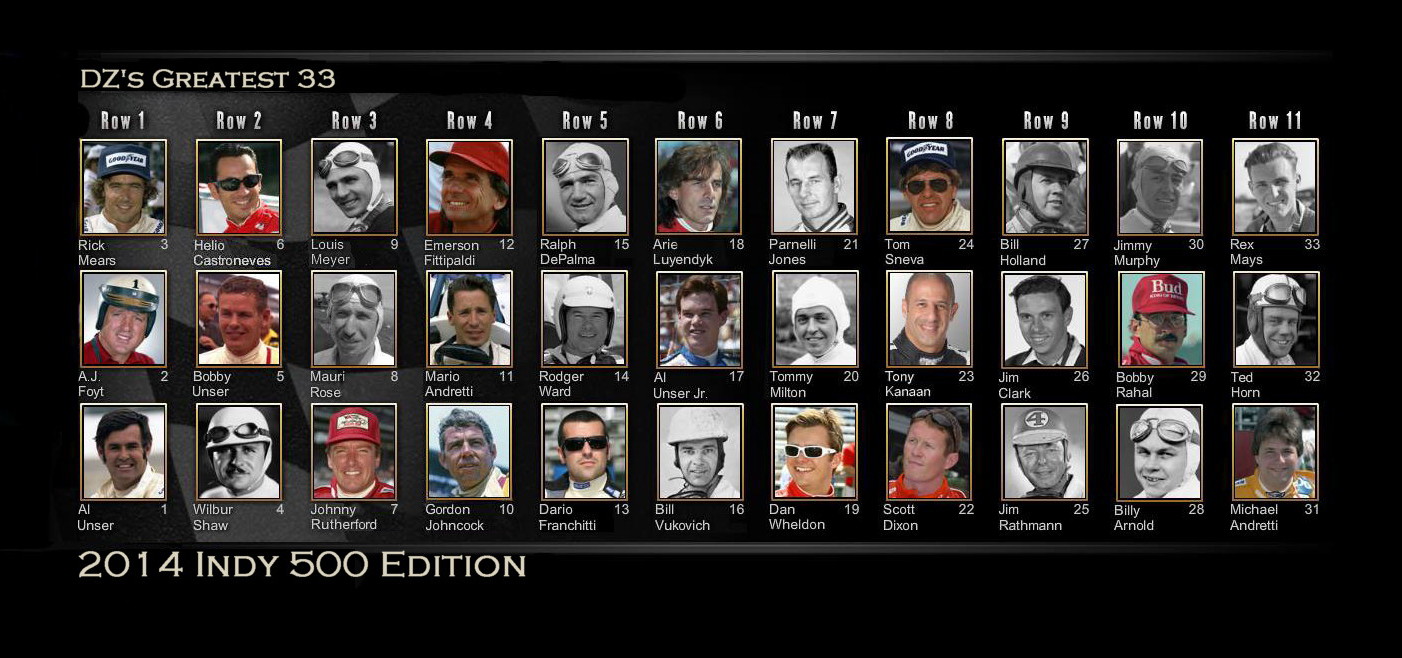
Here is my Greatest 33 following the 2014 Indy 500 results:


Rows 1 – 3:

Rows 4 – 7:

Rows 8 – 11:


And my criteria for helping select these drivers:

As you can see, emphasis is weighted heavily on winning the race, with additional consideration for Top 5 finishes, Poles won, Laps lead, and making the race. Michael Andretti, Ted Horn, and Rex Mays are the three highest rated non-winners at the expense of Buddy Lazier and Sam Hanks. 

For 2015, I am considering tinkering very slightly with the amounts of weight between these categories and also have given an intangible additional consideration for those who’ve also held track records or currently own a track record. 

I’m actually quite happy with this list although I think fair arguments could be made for other drivers in the one-win and no-win positions. This is how I choose to delineate my “Greatest” from the “merely great” or “very good”. 

What is of most importance and most exciting to me now is seeing what changes from year to year with the active drivers moving in the list. 

Will Helio, Dixon, or Kanaan, gain an additional win and move them each into the most rarefied of air in my Greatest 33? 

Can Carpenter, Marco, Hunter-Reay, Montoya, or even Lazier move into the discussion based on their results this year? 

What do you think of these cold, hard, numbers that marginalize the likes of Lloyd Ruby, Dan Gurney, Gary Bettenhausen, Jules Goux? 

These are things I enjoy pondering and makes following along consistently much more interesting. 

Let me know what you think about the legacy of The Greatest 33..


Gordon Moore’s Law and Indycar

It’s been over 50 years since those heady days of the 1960s science and technology boom in the US. Electronic (vacuum) tubes were soon to be replaced by an interesting, solid-state device, known as an integrated circuit board. (What was it about the 1960s that made it so damned amazing anyway?)

Gordon Moore was one of three scientists and partners who came to be known as the founders of the company Intel.  They developed their ideas, leading also to the development of solid-state memory devices (i.e RAM chips) and many other advances, which in turn, also begat the rapid advancement of not only computing machines, but also the manufacturing processes that were developed to create these amazing technological tools. April 19th, 2015 marks the 50th anniversary of a paper released by Gordon Moore which later became more widely know at Moore’s Law.

Still not ringing any bells? 

Don’t worry, I didn’t hear any bells either until I read this Economist article today regarding the 50th anniversary of Moore’s Law. Moore realized in 1965 that the microchip with all the capabilities of it’s solid-state integrated circuitry stated that the technology to produce microchip and to continually shrink the transistors would then allow for a doubling of transistors per unit of space in regular intervals (he settled on every 18 months or so), leading to an exponential increase in the ability of those circuit boards in addition to the decrease in cost to produce them. Largely his prediction held true, not for the 10 years as he foresaw, but nearly 50 years, longer than most ever agreed his “Law” would last.  

Eventually the increasing limitations of physical space lead to what is now being seen – a reversal of the decreasing per unit cost to produce to achieve that same or declining rate per area of microchip. (This is where the Indycar light bulb went on for me). 

In fall 2011, (maybe you were one of my tens of readers then) I wondered out-loud about the limitations and diminishing returns from increasing costs related to producing a leading-edge Indycar. Indycars (always in search of that next big idea to win the Indianapolis 500) were the working experiments in the laboratory of auto-racing which included design, manufacturing processes, and performance technology. From the early 1960s, steadily increased performance came with astounding regularity (and increasing budgets) until the early-1990s when it became no longer economically viable to build these amazing machines.  

The cost to produce a winner was becoming highly prohibitive to all but those who could be counted only on a bad-shop-teacher’s handful of fingers. Even the “unlimited” strata of F1 has hit a ceiling where costs and technology are outrunning those who would put resources to them.

So when considering how Indycars could be much better, don’t forget that at some point, power, speed, efficiency, technology, AND economic input per unit ALL reach a point that simply cannot be overcome. We found it in Indycars much sooner than with microchips. 

There was a time when the automobile was still new, out of the ordinary, looked upon with fascination and reverie. I grew up in the era when computers, for all their lack of personality, were also these amazing, cantankerous boxes that did increasingly amazing and streamlined tasks. 

So in better understanding that these are the times in which we reside, the current Indycar is quite serviceable for me, adequately and fairly delivering a racing product of enjoyment for those who partake. Short of blowing up the whole paradigm and having a totally unlimited format (including budgets), this is our Indycar, post-Boomer world.

Four generations since the automobile saw rapid development, and two since the computer did the same, the luxurious showroom shine is well and truly off the ‘Apple’ and we’ll likely see neither automobile nor computer with quite such fascination again. 

I can’t even imagine what the next big thing will be. 

Please just don’t let it be artificially intelligent android/robots. 

They’re simply WAY too creepy for me. 


J.W. von Goethe and the Ever-Esoteric Indycar

There have been several treatises written by many much more skilled than I dealing with the sturm und drang surrounding Indycar and it’s TV ratings (which is oft used by media and advertising folks to indicate its relative popularity in our culture, and, in some cases, to indicate relative worth in the commercial marketplace) so I shall not attempt to add to it.

Oh, wait. I already have. Back in 2012, here. Another one of quality by our long lost comrade in Indycar arms, Pressdog, can be read here. Read those in your free time later. For now, just understand that we’ve covered much of this ground before, and reference the continually, relatively small TV ratings outside the Indy 500 as a backdrop to this post.

Today’s Indycar Word of the Day is: Esoteric

esotericadj. es·o·ter·ic \ˌe-sə-ˈter-ik, -ˈte-rik\

1 a : designed for or understood by the specially initiated alone (a body of esoteric legal doctrine — B. N. Cardozo)
b : requiring or exhibiting knowledge that is restricted to a small group (esoteric terminology); broadly, difficult to understand (esoteric subjects)
2 a : limited to a small circle (in esoteric pursuits)
b : private, confidential (an esoteric purpose)
3 : of special, rare, or unusual interest (esoteric building materials)

For this writer, attempting to express ideas through words are typically a source fun and ‘esoteric’ is among the most enjoyable for me to throw out in conversation or print. Regardless, I find this word especially useful to frame what I saw as a very good race at Long Beach last weekend. 
For a sport that is already quite esoteric, to continually heap upon the negative comparisons to the glorious past of 50 (or even 25 years ago) serves no good.

You may think you’re doing the sport a great service, but you’re not. It is pure folly and unfairly shackles the sport to something it cannot possibly be. It reminds me of a younger sibling who becomes a freshman in high school, only to continually suffer the unfair comparisons by possibly more glorious elder siblings’ friends and teachers. To have these comparisons and judgements awaiting you, before you have a chance to develop your own identity, would be highly infuriating. Perhaps you were just such a sibling and can identify with this feeling, but I digress…

My point to all this can be summed up by a quote I came across yesterday attributed to Johann Wolfgang von Goethe – influential writer, statesman, and all-round free-thinker from late-1700s/early-1800s Germany. The english translation of his quote is,

 “the thing that is hardest to see, is that which is right in front of your eyes.”

What is currently (and has been for a few years) in front of our eyes is the gilding of a new group of Indycar legends. Yet nobody seems to care.

Scott Dixon scored his 36th career win in Indycar at Long Beach last weekend, surpassing the golden-era legend Bobby Unser, and moving to 5th all-time, a full year quicker and in 17 less starts that ‘Uncle Bobby’.  
Let that sink in for a bit.
I’m not going to attempt arguments which bring in subjective comparisons based on the sport or vehicle history – only the hardest, most basic statistics. We can certainly view them all through the lens of their time but I find it increasingly hard to say one era is better than another based on conditions of the time. Liars figure and figures lie, correct?
We are in a time when new legends such as Scott Dixon, Helio Castroneves, Sebastien Bourdais recently retireds Dario Franchitti and Paul Tracy, ALL are in the top 15 in career wins.
These drivers, some of whom are permanently gone from the cockpit, or likely soon to be, are legends in their own right, yet most often we only hear and celebrate the voices of those who continually lob mortars at the sport’s façade, quite unfairly damaging this current generation of legends. The worst thing, the absolute WORST we do as fans is depreciate their status.
(c) Jeff Gritchen – OC Register
I’m making an concerted effort to eliminate the unfair comparisons with the sport’s past. The drivers of today are legends in their own right, living in the shadows of the sport’s earlier legends, yet they’ve earned the right to be treated as such. 
The subdued congratulations from TK and Helio on Sunday, seemed akin to a knowing nod that despite the weight of golden-era legends and their esoteric, nostalgic fans before them, they do understand their place in the sport’s pantheon.
If only more Indycar fans did as well.


The Middle of The Road

“the middle of the road, is no private cul-de-sac…”
– Chryssie Hynde, The Pretenders

As my tens of readers may or may not have noticed, there was no post last Tuesday. Due to a much-needed and enjoyable vacation week, I elected to enjoy my day at the beach and pool rather than stuff more content of questionable quality on the internet.

I found that, even on vacation, Indycar is never far from my mind. Road-tripping for 19 hours with my family to the sunny climes of Gulf-coast Florida, allows for copious driving time and the mind will wander, although auto-racing and Indycar is naturally very close to the surface.
The only major lament I’d have from this trip is that, while spending a vast majority of four days driving out of the last nine, a vast majority of people simply do not know how or do not care to know how to act while driving on a major interstate highway (RANT ALERT). There is ONE very simple rule on interstates that would ease SO many traffic woes:


It was observed that a goodly many of drivers from such great states as Michigan, Ohio, and Indiana, seem to be keenly unaware of the laws of most every state in the union with regard to interstate driving. 

Perhaps they’ve not heard the cautionary words of Chryssie Hynde.


Perhaps they’re unaware of the consequences of such actions.
Perhaps they simply do not care. 

Perhaps they’re rude and unchivalrous with regard to road etiquette.
I find it quite an unseemly commentary on our society actually.

Regardless, it is in the middle of the road, where you do indeed see the darnedest things, and yes, it is no cul-de-sac. Seemingly safe and comforting to be in the middle farthest away from those scary edges of the known. Unnecessary traffic snarls and semi-close calls belie that it’s actually a treacherous place filled with danger. 

Just ask Kevin Cogan. 

Or Ryan Hunter-Reay.


I cannot say to this day, with the highest degree of certainty that Hunter-Reay or Cogan were totally to blame.  The preponderance of evidence seems weighted against them however and often the precise facts of the matter rarely count in the court of public opinion. Both did harm to their reputations as drivers and both did damage to the image of the sport to some degree.

Even the sport of Indycar itself shows a proclivity for the safety in the middle of the road with its oft-compromised decision-making and white-washing of the history of the sport.

Maybe I’ve just become more sensitive or tolerant of the realities of life. As I get older, the middle of the road isn’t seen as a narrow balancing point but has come to represent a vast grey area that lies between the narrow lines of either extreme. For a great many days of our lives it is relatively safe there, but for the increasingly binary times in which we now live, for better or worse, it has come to represent a place lacking a sense of gravitas and especially at critical moments in time.  

Rick Mears’ famous outside pass into turn one at Indy in 1991, en route to his fourth and final Indy 500 victory, was in no way considered middle of the road.  The fastest race speed he would turn that day going into one, taking the most extreme line possible with no guarantee of coming out the other side cleanly is an example of not compromising at precisely the right moment in time.  


And such is the stuff of legend.


The Power of Polls Compels You

It’s Tuesday already?!  

I thought I just posted a few days ago and here I go again?

This dubious self-imposed return to blogging has brought with it a dubious self-imposed schedule for posting every Tuesday. Me and my big mouth will surely run out of new Indycar things to discuss before April is out.

One new development I’d like to highlight was an opportunity with which to be involved, that came along right before the start of the aerokit-era – The Indycar Power Poll.

In similar fashion as many sports, This Indycar Power Poll is to be a basic guide for understanding the current and past performance climate of the participants of the particular sport. I happily joined this band of miscreants these esteemed colleagues who with nothing better to do than to weigh in on the drivers performances directed their creative talents to provide fodder for words add value to our collective readerships. Those aformentioned colleagues, each with writers all and with a dedicated interest in the sport of Indycar are:

Dylan Reynolds openwheel33.com @openwh33l

For other insight into the Indycar Power Poll, please visit those folks for their individual takes on this informal data and Indycar in general.

So just prior to the St. Pete race, we scrambled together a Pre-season Power Poll which, when our individual polls were compiled into an aggregate, looked something like this:

Preseason Rankings
Pos.
Driver
Points
1
Will Power
480
2
Scott Dixon
370
3
Simon Pagenaud
364
4
Juan Montoya
313
5
Tony Kanaan
299
6
Helio Castroneves
297
7
Ryan Hunter-Reay
283
8
Sebastien Bourdais
245
9
James Hinchcliffe
234
10
Josef Newgarden
198
11
Carlos Munoz
178
12
Marco Andretti
172
13
Graham Rahal
156
14
Charlie Kimball
148
15
Takuma Sato
146
16
Luca Filippi/Ed Carpenter
145
17
Stefano Coletti
143
18
Sage Karam
131
19
Jack Hawksworth
130
20
Simona De Silvestro
116
21
Gabby Chaves
90
22
James Jakes
89
23
Carlos Huertas
86
24
Francesco Dracone
62


As expected, we see some collective change following the Firestone GP at St. Pete

After Round 1 – The Firestone GP – St. Petersburg, FL – @GPSTPETE

Pos. Driver Points Pos. Change
1 Will Power
900
2 Juan Montoya
703
Up 2
3 Simon Pagenaud
640
4 Tony Kanaan
599
Up 1
5 Scott Dixon
596
Down 3
6 Helio Castroneves
577
7 Ryan Hunter-Reay
497
8 Sebastien Bourdais
466
9 Josef Newgarden
372
Up 1
10 James Hinchcliffe
372
Down 1
11 Marco Andretti
343
Up 1
12 Graham Rahal
322
Up 1
13 Jack Hawksworth
319
Up 6
14 Luca Filippi/Ed Carpenter
299
Up 2
15 Takuma Sato
297
16 Carlos Munoz
295
Down 5
17 Charlie Kimball
281
Down 3
18 Stefano Coletti
280
Down 1
19 Sage Karam
230
Down 1
20 Simona De Silvestro
213
21 Gabby Chaves
182
22 James Jakes
165
23 Carlos Huertas
148
24 Francesco Dracone
117

Perhaps, I was expecting to see Will Power fall from the top spot which would have been harsh in my view.  His dominance over the entirety of the weekend was reduced only slightly by a minor bobble in the pits which cost him the top spot on the podium in my view.  Montoya had an impressive and inspired drive which now invites more attention to his position compared with a year ago.  Scott Dixon took a tumble down the ranking but much like Power’s not really due to anything in his control.  Munoz, who had a very pedestrian day, tumbled the most from 11th to 16th.  Jack Hawksworth was a pleasant surprise for the Honda contingent, battling to 8th after falling to the back early for Lap 1 wing damage. Personally, I had Simon Pagenaud tumbling a bit more than the aggregate and Helio a bit higher here as well, largely due to the dominance of the Penske machines.


And a old, early-blog item is also returning as a regular feature – The Flags of Opinion.

Red Flags
– The Dumbest Question That Could Be Asked On Raceday: Please retire immediately the most tiresome and unnecessary part of the raceday experience just prior to the command, “Racefans, ARE YOU READY?”. As noted on other blogs, this most tiresome and rhetorical of questions is more than overdue to disappear form the raceday experience.  Please, please, make it go away. 
The Flying Debris: Yes, I am aware that on the ticket stub that I printed out (on my home printer at my own cost), there is a disclaimer that spectators assume all risks of being at such an event where things can and will go wrong and potentially become injurious to spectators. Thanks liability lawyers and insurance plans, we are aware, however if the object is to bring more people to your event and not less, containing race debris is of serious concern. Racing in America is already becoming marginalized and getting a skull fracture (or much worse) should be the least of our concerns.

Yellow Flags
Driving judgement: More of it please. I understand you drivers are all eager to impress/do your best. Sometimes less is more. Cars that minimized contact generally finished higher than those that didn’t. Mid-pack back is without question going to be a real scrap this season, with many drivers desperate to retain their driving privileges. Even 2nd place Will Power could have waited a handful of laps to better set-up his pass and possibly recover his only lost position of the weekend. 
Confirmation Bias: Cheever has proclivities to opinions and will look for any shred of evidence to support his sometimes tone-deaf claims. Hearing his praise for Marco’s driving was particularly off immediately following young Andretti’s attempt to pass where there was no room. If we’re one of the 400,000 worldwide TV viewers, we’re already pretty astute to the Indycar environment already. Don’t need additional opinion and commentary to help me interpret what I’m seeing, thank you.

Green Flags
Aerokits: Yes, the certain scapegoat in each and every yellow flag situation this season that causes more than a two-lap delay in restart. Folks, it’s like this, if drivers don’t bang their cars together, there will be no yellows for contact or debris. The aerokits provide more driving and technical intrigue to this sport than we’ve seen in a very long time. I want to see how this season plays out. I’m a very strong proponent of the aerokit plan because it will force some much needed uncertainty in each event. Let’s watch it playout over a season, not judge it based on one half of the first race.
Intrigue: Oh, this word is an early contender to the be the most used noun in my blog this season. How will the aerokits perform? Can Honda beat Chevy? Can Penske be stopped? Will Simona survive in Indycar? Who will be a surprise winner this season? Will Honda dominate ovals the way Chevy dominates the streets? So much newness to it all and I’m more excited than I’ve been in many years. Lots of interesting bits to consider when everything isn’t the same from garage to garage. Instead of marking time between my select few favorite races, I already can’t wait for the next race. Hurray for excitement!

Yes, I’ll say it again..

HURRAY FOR EXCITEMENT!

SuperMegaComebackPost: Sir Issac Newton, The Breakfast Club, The Crystal Ball, and Change

Newton’s First Law of Blogging: 
Blogs at rest stay at rest,
 Blogs in motion stay in constant motion,  
unless either is acted upon by another force.


My blogging inertia was acted upon by a recent reminder (active mention on video) of my visit to Nashville which gave me time to hang out with our good Indycar friend George Phillips of Oilpressure.com and @oilpressureblog fame. 


His gracious allowance of me as a guest on the recording of his “One Take Only” video segment, which appears on his blog, was a treat and a great and all-too-brief experience. Joining us was his original One Take Only counterpart, John McLallen and the three of us spent most of a gorgeous early-autumn Tennessee Saturday afternoon discussing all manner of things, but mostly the centering around Indycar.

After another “One Take Only” post, I reflected on my visit and noted how, despite our different points of view, we also need to remember and reinforce the commonalities shared as Indycar fans. Sequestered in relative solitude on George’s back patio, our various discussions, while not nearly as intense, did make me recall the John Hughes movie “The Breakfast Club” (which recently celebrated its 30th anniversary theatrical re-release) and how we fans may not be so dissimilar to the characters in that movie.


Perhaps writing a letter similar to Brian’s in the movie will also remind us of how we should not so easily let others or ourselves be defined by the various ‘entrenched encampments’ of Indycar fandom.

Mr. Indycar-Overlord, 

We accept the fact that we had to sacrifice so many Saturdays and Sundays supporting Indycar, but we think you’re crazy to make us write a blog telling you who we think we are. You see us as you want to see us, in the simplest terms, the most convenient definitions. But what we found out is that each one of us is

a superfan,
a newbie,
a whiner,
an acolyte,
and a hyper-critic.

Does that answer your question?


Sincerely yours,

The Indycarfan Club


And now, It’s time for the Intermission…


And now, back again for the 2015 Indycar pre-season,

it’s DZ’s House of Indycar Megalomania! 

(aka 2015 season predictions and strident drivel)


Oh, epochal and monolithic Indycar off-season. You are so coy. 

With your belabored and long, somnombulant winter, you keep us in the doldrums until suddenly, 

>BAM!< 


exploding forth a lush, verdant optimism for Indycar in the form of.. (dare I actually believe they’re here).. AEROKITS!  

Technically 3 years late (or approximately 5.333 Indycar seasons stacked end-to-end), but here nonetheless. With the first discernible chassis diversity since the end of the 2008 season, Indycar has finally delivered on the concept approved in 2010, backed up along with new chassis until 2011, then slated for 2012, delayed until 2013, 2014.. ehhhrm, we’ve all been through that so no need to rehash it.


Regardless, aerokits are here and despite my 2011 predictions otherwise, I am pleasantly surprised at the difference in shape the Road/Street/ShortOval kits. 

Dare I say it? 

I dare.

I. Am. Satisfied.

And now for the grisly prediction bits.
(unofficially brought to you by the effects of Founder’s All-Day IPA)

2015
Biggest Storyline – Penske’s Chevys will dominate – to the point of becoming so oppressive, that they will become reviled.  Robin Miller often says, ‘hate is good’ when referring to the fans’ predilection for seeking out a hero or villain in any contest. Whether he means to or not, Penske will become the Indycar version of the New England Patriots – the most disliked team outside of “PenskeNation”. Even ol’ Chippy will let his ego slide and actually play up his underdog status to ride the wave of anti-Penskeness. Roger and Tim maintain their ZFG (Zero F***s Given) ‘tude and happily cash the giant cardboard winner’s checks for 8 of the 16 races this season.
– Championship – Simon Pagenaud.
– Top 6 in points will be made up of 4 Penske drivers and 2 Ganassi.
– The Galactic Empire is strong and will keep the Rebel scum on the run.


It’s not as if Honda won’t be competitive, they will. They will just be lacking that tiny, tiny margin that takes one from finishing 8th to 1st. Honda wins just three races of the season, BUT one of them will be the Indy 500.

Rookie Of The Year – Stefano Coletti. Don’t ask me why, just know it came to me in a dream (All-Day IPA haze).

Biggest Darkhorse – TIE: James Jakes and Gabby Chaves. Don’t be surprised if you’re surprised when one of these drivers scores a podium this year.

Best Livery – If that Schmidt-Peterson Motorsport Spyder car becomes reality on the track, you can forget all you ever thought about the glory of retro liveries. That mo-chine looks simply badass.

Biggest Comeback – Simona de Silvestro. Of course she’s a fan favorite on a massively talented and well-funded team. She’ll struggle to see more than half of the races this season, but will not disappoint the faith placed in her by Andretti Autosport.  Less than half the races and finishing 14th in points will be hard to reconcile.  Just maybe AA finds a way to keep her in a seat all season long. If so, watch out.

Biggest Disappointment – The fans who align with the Legions of the Miserable. A season of dominance by one team will certainly lead to the chorus of boo-birds who will choose to again aim their venom at the overlords of Indycar for the disparity in racing. Their myopic views conveniently forget to accurately recall during the most heady days of CART in the 1980s, for example, despite a Gordy and Rick Ravon Mears most amazing Indy 500 finish in modern history, that 7th place Jim Hickman was a full 11 laps down at the finish. 7th place out of 33 racers – 11 laps down. Typically in those days, beyond the top 5 or so finishers there was the rabble of twenty or so others who had no chance of sniffing the podium. A singularly great finish but great overall quality, the events were generally not. Far too many fans, including one R. Miller, will further mire themselves in nostalgia for a time that was really less entertaining racing that what we’ll see in 2015. That is simply sad and I think the current sport deserves better.

With 10 of the 16 races non-ovals, and all of the major conflagrations occurring outside the ghostly hallows of influence that ovals once held, the high-water point for the new speedway kits be at their unveiling in Indy, May 3rd. Once May is over, the Speedway Oval kits get precious little use, in deference to the mighty cheese-graters of R/S/SO kits.
I really don’t expect much difference at all in the High Speed Oval kits and honestly (leads me to my Biggest Revelation), “it just doesn’t matter.

Why do I say this?


Because, my friends, I’ve returned to this blog an enlightened man.

In my many winters of malcontent, discontent, and general dissatisfaction in the direction of Indycar in relation to its glorious past, I’ve given up hope. Sounds bleak perhaps, but I assure that it is not and I’ll tell you why.

For some unknown reason, my epiphanies have been many with regard to several sports since the last checkered flag flew for Indycar in 2014, one of which is giving up hope that Indycar will ever become anything closely resembling the past or having some gloriously innovative and wide-open future. Maybe I’m a late-comer to this method of thinking, especially compared to the 20-somethings/new guard who’ve never experienced first-hand a field of Offys and Drakes, Chevys and Cosworths, in glorious song and never will.

For better or worse, nothing can change the fact that the past shall always remain there and I’ve come to believe the nostalgia, no matter how well-meaning or beloved, is ultimately harmful to the sport of today. The ‘earth’ moved by the seismic rift that began with the formation of CART in 1979, and major aftershock of the formation of IRL in 1994, can never be repaired. The ground has irreparably been shifted. So to history it all shall be laid anyway. Indycar must promote the here and now, and forget trading on past glory which always lends to irritating old wounds.

It’s a time to heal.
I’ve changed.

I’ve reconciled (finally) with Indycar never being the hallmark of innovation and brutal speed that it once was.

I’ve accepted that the glories past can never be recreated, and that they shouldn’t be.

I see many things on the horizon for Indycar that will give me much entertainment and satisfaction, when I don’t look at it from the immensely-removed perspective that includes anything prior to the last 10 years of Indycar.

I’ve embraced the belabored arrival of the aerokits.

I’ve finally made my peace with saying goodbye to the old Indycar.

I’ve become a happier race fan for it.

I predict I’m going to love watching Indycar unfold this season, and I know that’s one prediction I won’t miss.
Initial Feedback – The Inaugural Grand Prix of Indy

Mug-N-Bun never fails to satisfy

Following the #GPofINDY, and surviving a near brain-freeze from rapidly trying to ingest too much Mug-N-Bun root beer float, I had a three-hour drive home to recount the day’s events. 

It’s my opinion that direct and unfiltered customer-to-provider feedback is a good thing and especially when the experience is fresh in the mind. Upon returning home with sleepy family members in tow, I resisted my usual race-return tradition of watching the TV coverage and sent out only my most vivid impressions via Twitter. The immediacy of approximately five thoughts, I thought, would gather a decent snapshot of my experience. 

Listed below are those tweets in chronological order, which ended up being forwarded by a follower of mine to Douglas Boles, President of the Indianapolis Motor Speedway.  He graciously responded. 


Who knew a blowhard blogger such as myself can provide useful, concise, and unbiased feedback? 


The President of IMS, that’s who. You’re a good man, Douggie Boles. 


I encourage all you reading this to add your own ON-SITE facility experiences in the comments below, and save the racing and TV critiques for other places. I believe that no opinion is ‘right’ or ‘wrong’, as long as you strive to be as fair and honest with your input as possible. 

I’ll be happy to forward all of the input I receive to the uppity-ups at IMS. The more ‘pixels’ we have from the event, the better the overall picture they’ll have.