The Second Race I Attended

If you’re currently an Indycar fan or just a fan of the Indy 500, a vast majority of us would recall with great reverence, that first race we attended and became hooked on the entire sensory experience.

How many of us recall the second race in a similar manner, however?

My second race came in 1980, one year after my first. 1979, while a fantastic experience and cementing a lifelong love of the speedway (and also strengthening my bond with my father), left me wanting in the racing department because my favorite driver (Al Unser) in what was the best car on that day (the new ground-effect Chaparral), dominated only to drop out with a minor part failure (transmission seal).

The following year I was even further disappointed to learn that Johnny Rutherford would be piloting that formidable and glorious yellow machine for 1980. Al had moved to a new team with a rather squarish, white (Longhorn) car spectacularly unadorned with sponsors and terrifically average on the speed charts all month. This was not a good sign for “my man Al”, I thought.


It was the dawn of a new decade. The newly-inaugurated president of the United States, Ronald Reagan, seemed to symbolize the promise of unity and common good needed for much of a country that was hurting from the recession years of 1978-1980. In a reflection of the times (which I continue to note to this day), the uncertainty people felt in the economy was also felt in the racing community. 

Much uncertainty existed for the USAC, fledgling upstart series CART, the cobbled-together CRL (Championship Racing League), and IMS. Tony Hulman had been gone less than three years and the power vacuum was being filled by multiple, divergent sources. 

Teams raced on though. Some preferring the traditional USAC trail which was in decline with cancelled events later in the year, and some teams joining CART and attempting to grow their own series. This was the original “split” that fewer discuss when looking at the history of open-wheel racing in the US. Despite the uncertainty, the Indianapolis 500 Mile Sweepstakes was an unquestioned titan and, for the time being, remained steadfastly on the schedule of both sanctions. 

Race Day 1980 was quite beautiful, hot, and sunny making that Pennzoil Chaparral gleam even more brightly than the previous year. I knew better who this no-name Mears guy was who’d won the race in just his second try the year before. The cast of legends were all there and fairly competitive with a myriad of chassis and engines as the dawning of ground effects seemed to inject some optimism into experimenting.  

The new decade seemed to give hope that the future in general was brighter. Around 29 eligible drivers and over 40 cars missed the field for the 1980 race which seems incredible to imagine in this age.
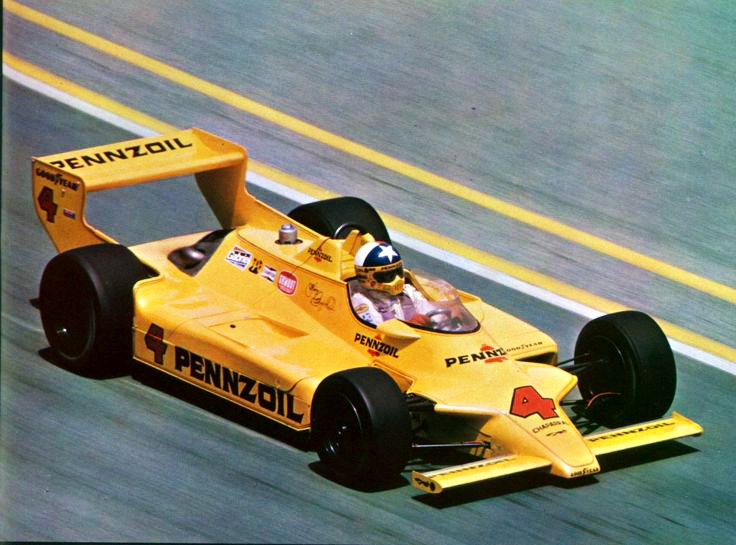


The domination that we were expecting of the “Yellow Submarine” in 1979 bore fruit in 1980 as Rutherford had a nearly flawless day at the lead of the race for 118 of 200 laps. Tom Sneva, who wrecked his 14th-quickest and already qualified primary Phoenix chassis in practice after qualifying, used a backup McLaren to drive from 33rd to 2nd, even leading the race twice for a total of 16 laps.

It was a day that wasn’t particularly notable for the racing, aside from Sneva’s excellent run from the back of the pack to 2nd and Rutherford gaining his third 500 crown.

While we waited to leave the infield parking location, my two friends and I left the three fathers back in the vehicle to go stretch our legs (and alleviate some of the boredom of sitting in a hot car going nowhere). Wandering about provided an education of things heretofore unforeseen by these eyes.

This would be the year that I (quite innocently) had wandered too close to the infamous Snake Pit of yore where my first-person accounts of the adult female anatomy would be made much more complete than ever before. And displayed in incredible fashion. Live and in color, the details of which aren’t exactly suitable for public discussion. Perhaps someday, if we meet and you’re truly interested, I’ll provide the event’s details.

My 12-year-old self could scarcely believe what we were seeing and I am still quite incredulous to this day. I’m quite certain that if our fathers knew what we were witnessing, they’d have preferred to keep us in the vehicle.

Also, of particular note was my first live-action brawl between adults. Only in recent years did I see a picture of this incident captured by the Indianapolis Star and posted in their annual flashbacks.  Part of me wants to discount some details of the event I saw as boyhood embellishment, but I DO have certain elements reconciled in my brain as correct based on this photo, so while sparing some of the lengthy details, I can say that I witnessed this moment of Snake Pit lore from a range of approximately 30′ which seemed far too close once all hell broke loose:


Again, perhaps someday I may regale you in person with my memories of this alcohol-fueled contretemps but safe to say, my second Indy 500 was nearly as memorable as the first, just for vastly different, non-racing-related reasons.


The Ugliest Car to Qualify at Indy

One of the closest and most exciting finishes in Indy history came in 2006 when Sam Hornish, Jr. passed Marco coming down the front straight within 200 yards of the line on the final lap. Never in the history of the race had the lead changed so closely to the line. My seats were located on the front straight that day just beyond the start/finish line and the noise from the crowd was deafening as it had been only a few times before.

It was an amazing end to a race month that was filled with ugly weather and one of the ugliest cars to ever qualify at Indy.

The two Rookie Orientation days of the month went smoothly, but 7 out of the following 11 available days, including qualifying, were either shortened or cancelled completely by rain. Qualifying was compressed from the ’11/11/11/bumps’ four-day format to two days. Unfortunately for some teams, there was precious little time to get marginal cars up to speed. PDM Racing was just such a team. 

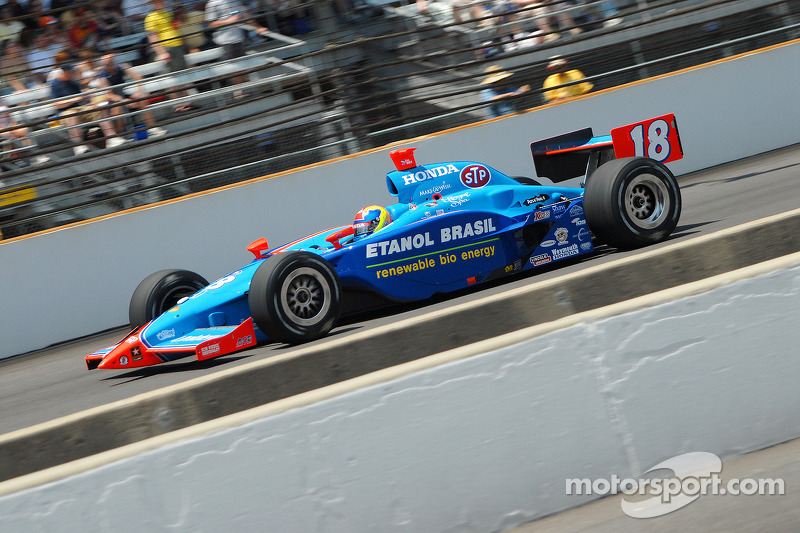
A smaller-budget team already battling money, time, and the elements just to have an opportunity to make the show. Their rookie driver Thiago Medeiros, the 2004 Infiniti Pro Series Champion, worked well through his Rookie Orientation Procedure in this cobbled together mess of a G-Force chassis on May 8th: 

(c) 2006, Jim Haines, Motorsport.com

The PDM effort was dealt a serious blow when Medeiros crashed and severely damaged (although judging by aesthetics, that may be a relative term) their lone chassis late in the limited practice of Thursday, May 18.

Just two days remained if PDM was going to be able to even attempt to make the race. One final day of practice on Friday and Saturday’s Pole Day qualifying later, 32 cars were proven to make the grid, leaving the team of Marty Roth Racing and PDM the only two fighting for that final spot.

The team spent those two days scrambling to find money and parts and time to assemble their one chassis to have their lone, Bump Day shot at making the race. And what an ugly chassis it was. With some unpainted or scavenged, mis-matched parts, a few sponsor stickers, and lots of elbow grease, the PDM team worked for two straight days and nights to get the already abysmal appearing “Frankenchassis” of a Panoz to the limited practice available prior to the final day of qualifying on Sunday, May, 21st.

Due to lack of qualifying attempts, most of Bump Day remained open for practice as teams prepped their Race Day settings. Drama arrived late in the afternoon in the form of A. J. Foyt Racing who surprisingly pulled a third, prepared chassis from their stable and employed the experienced Ryan Briscoe to possibly qualify the number 48.


Adding pressure to what had already been a highly taxing 48 hours for PDM racing, they returned from the garages with less than 60 minutes remaining, following some final changes, a new sponsor sticker, aero parts from what appeared to be no less than 6 different origins, and presented their car for qualifying attempt number one at 5:03pm

(c) 2006, Dan Vielhaber, Indymotorspeedway.com
(c) 2006, Gavin Lawrence


It is fairly certain that to all who followed this story, breathing was done only as minimally as possible.  All of PDM Racing’s hopes and aspirations for the 2006 Indy 500 were riding on the four laps that Medeiros was about to take.

Thiago managed to qualify the car on his first attempt, nearly bouncing the 32nd car to 33rd, but slowing enough on the final lap to be set “on the bubble” for the remainder of the day. As the clock ticked and Marty Roth presented a car for qualifying, his hopes were dashed in warm-ups when losing control of the car and colliding with the Turn One wall.

Perhaps mercifully, Foyt withdrew their third car from the qualifying line, and as the gun sounded at 6:00pm, ending qualifying for 2006, underdog PDM Racing and Thiago Medeiros must have felt nearly as jubilant making the field for the 2006 Indy 500 as winning it.

PDM’s raceday version of the car was a sight for sore eyes and a marked improvement over what was until then, perhaps the ugliest car to ever contend during the month of May.

(c) 2006, Earl Ma, Motorsport.com


How Tennis Confirmed That I Could Never Drive an Indycar

I play sports as a way to get some exercise, but more as a way to challenge myself and assess my skills. I love to compete – fairly, cleanly, honestly. I play many sports for the competitive aspects or for the enjoyment of learning a sport new to me, but one sport I play simply for the fun of it is tennis. 

Currently my Monday nights are filled with a group of mixed doubles players that originated over 20 years ago. Only one of the original couples from that bunch still plays. They went from being the youngest couple at inception of this group to being the most senior couple currently playing. I’ve been playing with this bunch for about 9 years and am now in the upper half of ages now.

I find myself most excited about chasing down impossible ‘gets’ and returning them, to the dismay of my most-often younger opponents. It’s a part of my DNA apparently, or perhaps I was a Golden Retriever in a previous life and chasing tennis balls is a purely joyful exercise.

Last night was no exception. As my partner and I attacked the net, I anticipated their lob over her and began to track back behind her. Their crisply-struck baby-lob just cleared my partner’s racquet, dropped gently in the back of our court, and was headed away from me. I gave chase and managed at full-tilt to just flick a shot back over my shoulder feeling like it was just solid enough to return to the opponent’s side of the court.

Now is where being the elder and trying a bit too hard became a liability.

My momentum from the all-out sprint, carried me well-beyond the back of the court, and in trying to extend myself fully to get a racquet to the ball, and losing balance, stumbled slightly which did not allow me to slow myself properly before hitting the chainlink fence behind the court. I still have a picture in my head of what I saw right before impact. 

There was a millisecond of silence after the ball left the strings and… >BANG<

I managed to collide with the fence right at a vertical post. With my face. My arms all splayed about trying to complete the list of things, perhaps in the wrong order (flicking the racquet into position for a shot, keeping my balance, protecting my face from the impending impact, etc.). Nevertheless, I quickly recovered to see that the ball was still in play, on the opposite side of the court, being easily volleyed away and we lost the point. 

It hurt.

I still have cuts and abrasions on my forehead and nose… and knee… and elbow… and cheek from the things I saw right before impact. The greatest pain found however, was my bruised ego.

Illuminated for me in an instant was a much more important point that wasn’t tallied in this contest – sometimes trying too hard is not in fact beneficial to the overall result.

It reminded me that what happens in an Indycar isn’t terribly dissimilar, only on a much more severe magnitude.  When I realized that it is, in fact, within my nature to chase things from a nearly-impossible position. I knew that this is a trait which is the precise opposite of what is required to drive an Indycar successfully. 

No driver I’ve ever seen in Indycar has said that they got more out of the car that it gave them. Drivers are instructed quickly very bad things happen when you try that.

Not that I could ever, but I think as Indycar fans, we all harbor the slightest illusion or fantasy of driving and Indycar at race speeds around IMS. Guess what? If you’re reading this, it’s likely in the extreme that you can’t. In fact, pretty close to none of us can do it. Maybe a late-comer to feeling like I have enough evidence to believe this, but far too many people (an many newcomers to Indycar who comment on the live practice feeds) don’t understand the difficulty of racing an Indycar at IMS around such a ‘boring’ oval.

I’ve even been fortunate enough to have done the two-seater ride and the single-seater ride at IMS. According to what I was told, my gear-limited top speed driving myself was approximately 149 mph. On the straights it was thrilling.  In the corners it was really quite overwhelming to the senses. And this was only approximately at 60% of what the current drivers experience, NOWHERE near the limits of adhesion that they deal with every corner of every high-speed lap. It was a bit of a eye-opener for me, realizing that there is something I could never physically or mentally do.

Not without smashing into a fence at some point anyway.

So, while watching these drivers on TV, try to realize that what appears quite like a simple Sunday drive around a simple four-turn course, isn’t, and is something you most likely will never be able to. Appreciate the subtleties of high-speed oval racing.

Even if you can’t see them, understand they’re there and that because they make it look easy, should indicate just how great these drivers are.

Wake Up The Echoes

The line “wake up the echoes”, as almost everyone from the northern part of Indiana would recall, is a lyric from the Notre Dame Victory March. The line is set within a stanza implores one to recall and revive the glories past;

Cheer, cheer for old Notre Dame, 

Wake up the echoes cheering her name, 

Send a volley cheer on high, 
Shake down the thunder from the sky.

Growing up where I did, Notre Dame football and the Indianapolis 500 once held an unparalleled significance in both long-standing tradition and celebration on an annual basis. I still see similarities with this sentiment and the opening day at IMS.

Opening day of 500 practice reminds us of a few things that acknowledge time and place; another year has ticked by, we have indeed survived another winter (which for Northern Indiana tends to be a bleak and oppressive 4 months), the optimism of spring is well and truly beset around us, the greening of the landscape signals the onset of more comfortable climes, and the quickening of pace to all things Indiana, especially the cars at Indy. My recent visit to the Indycar Grand Prix followed by this opening day also has awoken my restful desire to write here again. 


After being at IMS this past weekend, I appreciate how I find something special each visit there. Whether recalling specific visits or events past, or how the physical grounds and surroundings change over the years, or a mixture of people, time, and place, each visit seems unique and never repetitive. This past weekend I was not only engrossed with the racing, but also noticing what’s new around the track and in the museum.

Of special note to me was the A.J. Foyt exhibit in the museum and the demolished Lola tub on display that had been saved from his horrific crash at Road America in 1990. It takes very little imagination to see what damage was done to his body in that crash.

While presented as a testament to his incredible toughness and desire to return to racing following that crash, I am also reminded of how incredibly dangerous this endeavor is, despite the ongoing improvements to safety. Maybe it’s my steadily advancing age, or the fact that I’ll be attending my 30th Indy 500 this year, or that I’ve been following the sport for around 40 of my 49 years, but the fragility of life in the profession of Indycar racing seems all the more apparent now. In light of the length of my Speedway history, Hinchcliffe’s crash still seems like yesterday to me.

There is that dark and rarely officially discussed thread of mayhem and death woven into the history of the Speedway and while there is no need to glorify it, I also feel it quite important and well overdue to more suitably, publicly, and solemnly honor, via a permanent museum place or exterior monument, all those (fans included) who have given their lives from the events within the confines of the Speedway.

There really needs to be no shame in doing so, I feel. The drivers all eagerly acknowledge this risk in trade for thrills, riches, and glory. To publicly exhibit some condolence to those who were far less fortunate seems a fitting and necessary counter-balance to the weight of glory.

Many acknowledge a ‘spirit of the Speedway’ that they experience when visiting. While difficult to substantiate in a logical way, I’ve felt it as well nearly every visit. I don’t think it a stretch to consider that something well beyond our understanding may be ‘touching’ our psyche in those moments and to me, it feels as if it is from those who are gone.

Hokey-sounding perhaps, but I can assure you something I’ve experienced, and not imagined. 

So before I succumb to the annual rites of celebration and ‘shaking down of the thunder’ that arrive with my annual trip to the Speedway for the Indy 500 weekend, I’m feeling the need to take a moment today, this opening day at IMS, in solemn reflection of those whose lives were forever altered or mortally concluded at the Speedway. 

If nothing else, I’ll take those moments when they come (much like today) to consider the lives lost at the speedway and extend into the sky/universe a solemn acknowledgement of their sacrifice.


Lead, Follow, or Get Out of the Way

There is an axiom that floats about the business world, “people will tell you what they want, if you just listen to them”. The most successful salespersons and businesses shut up and listen, examine that information, and then figure out how to best provide it.

Today the Formula 1 drivers Association also took their concerns to F1 via an open letter to the ownership and directors of that sport, expressing a desire to see better stewardship of the sport with regard to long-term vision and plan. It all sounded so familiar. I even mentally inserted “Indycar” anywhere the words “F1” appeared with very little difference in consistency with issues known in Indycar for decades.

I thought to myself, ‘here’s yet another example of how Indycar has lead the world of autosport by 10 to 20 years’. We’ve been dealing with a sport whose organization can be characterized by the public as insular, short-sighted, lacking vision, and reactive since the late 1970s and especially so since the mid-1990s.

The good news for Indycar is, that is a bit farther up the road in dealing with a business ‘contraction’ than F1 or even NASCAR. The bad news is that the progress has come in fits and starts and is always much slower than the customer would like to see. It also comes at a time when it competes with ever-more diversions for the public, never less.

So how is it then, that a company can be perceived to be so aloof, especially when the lifeblood of its existence (sponsorship and broadcasting rights monies), is based on having eyeballs and ears on the product?

As we draw ever-nearer to the incredibly massive landmark 100th Indianapolis 500 Mile Race, we again are reminded so vividly of a sport that has been extremely adept at holding up it’s super-speedway, golden era (early 1960s to mid-1970s) as the hallmark of it’s existence and implying a parallel with the modern day. Those who have lived long enough to have seen those days with our own eyes and ears, always bristle at the comparison and rightly so. The sport today resembles so little of that Golden Era. The fact that we STILL gush more about the innovation of 1961 Cooper Climax, or the 1967 Paxton STP turbine, a full 50 years later than we do about the one that won just 11 months ago, or even two weeks ago, I’ve always found to be quite telling.

F1 has also been good at holding itself up as the pinnacle for newest and most innovative technologies for decades. It some ways it actually has, but as for the management of the sport, it’s still shows a heritage with the Draconian-types of the industrial age. 

At one time, the production auto industry used autosport as a working laboratory for development of better machinery to be translated into the passenger vehicle. Now it appears a new day is dawning in the automotive industry where technology is rapidly changing the mobility vehicle and how we engage with it. Likewise, there is an opportunity to examine those changes and see how autosport can incorporate them into their future.   


I’m reminded of that famous phrase, uttered in front of a shiny, new ‘K-car’ c. 1981.

I’m not sure if he originated the phrase, but I recall quite clearly for well over 30 years now, Lee Iacocca, then President of Chrysler, making that quote famous via his television ads for the ‘new Chrysler Motor Company’ – “In this business, you lead, follow, or get out of the way.” 

At the time, the car company was attempting to emerge from a terrible recession and bring a new philosophy, optimism, and ambition to the fore. It was a successful campaign in many ways although it didn’t solve all of the ills that plagued the company or the industry as a whole.

Autosport is still a reflection of that industry in many ways, especially by being tied so closely to the worldwide auto industry for obvious reasons, but I think the future will hold that the sport who was able to show the ability to listen to all voices of interest (not merely a few select ones), establish a forward-thinking and relevant vision, a clear plan to achieve it, and provide the product that people will demand in the future, will be the most successful. 

Even at it’s relative nadir, Indycar can still be a player in that game. Once the celebrations, revelry, and nostalgia of the landmark 100th Indy 500 end, I believe strongly that a new era must begin. One that is bold, exciting, invigorating, and isn’t afraid to be something innovative.


“Fear can hold you prisoner, hope can set you free” is the promotional tagline from one my favorite movies, “The Shawshank Redemption”, which was adapted from Stephen King’s Different Seasons group of novellas. Rita Hayworth and the Shawshank Redemption represents the season of Spring and is also subtitled, “Hope Springs Eternal”.

The character of Ellis “Red” Redding in that story cautions the reader (through a dialogue with the optimistic protagonist Andy Dufresne) that “Hope is a dangerous thing. Hope can drive a man insane”. Later, however, in reply, the character of Andy Dufresne states, “Hope is a good thing, maybe the best of things, and no good thing ever dies”.


I still hold out hope that Indycar can be the pinnacle of modern autosport it was.

I hope I’ll be able to make it to that day.

I hope to be there and shake my Indycar friends’ hands. 

I hope that Indycar will be as incredible as it has been in my dreams.

I hope.


The Greatest 33 – 2015 Post-500 Edition (aka Rambling Indy 500 nerdery alert)


Without deigning to delve into Detroit’s drenched driving debacle, this week’s post will focus on the update to my Greatest 33, post-2015 Indy 500. If you recall the post prior to the race, I pondered how this might change depending on who won, lead laps, and finished in the top 5. Change it did.

After a few very minor tweaks to the formula prior to the 2015 Indy 500, I had reconciled the slight discrepancy in weight of winning versus the other statistics I use to rate the drivers. It had a very slight effect in that by increasing the value of a win and a pole by approximately 10%, relative to everything else, and decreased a top 5 finish by 20%, winning is as important a criteria as ever. Some drivers who’ve enjoyed more success in winning poles, received a slight upgrade, versus those who may have won but perhaps lead fewer laps, or managed a top 5 for example. 

As you may recall, I also have my own “Last Row Party” made famous by the Indianapolis Press Club Foundation members for the rather dubious honor of starting in the last row.  My last row is a specially designated place for the three best ever to have never won. Essentially, I have a Greatest 30, plus three with careers of significance, but lacking that final turn into victory lane.

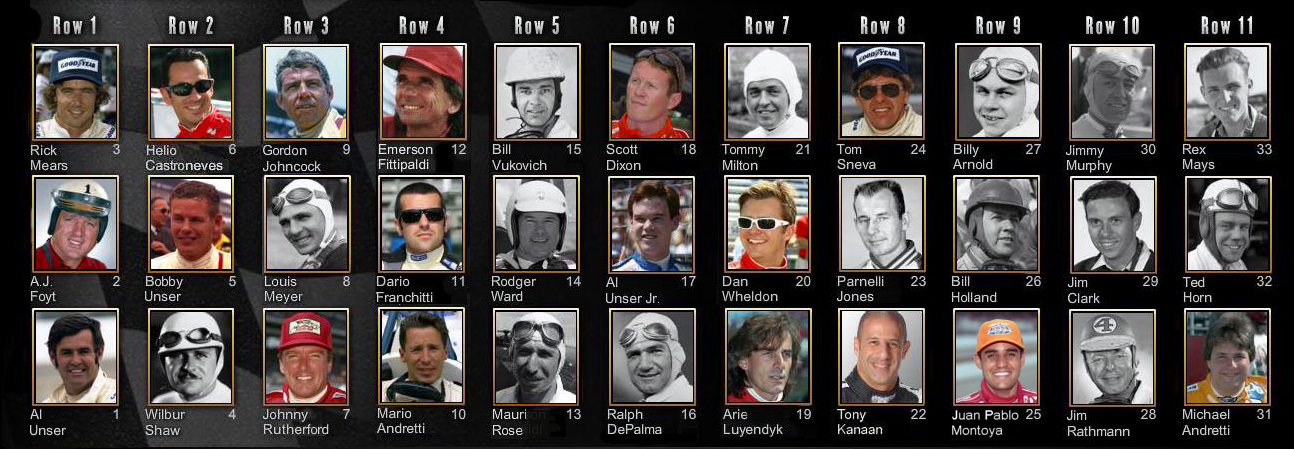
Found as the cover photo on @groundedeffects Twitter, here is my Greatest 33 following the 2015 Indy 500 results:


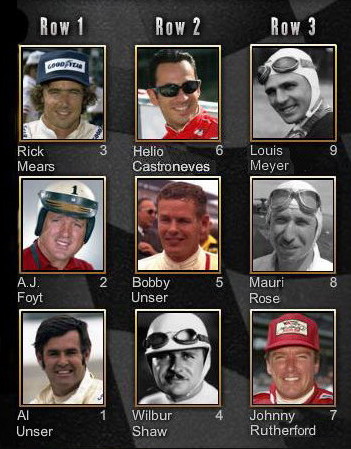
Here’s a closer look by groups of Rows…


Rows 1 – 3: Unchanged due to Helio not adding a 4th win to his tally.

Rows 4 – 7: With the slight change in scoring Franchitti gains one spot over Fittipaldi by virtue of an additional win, but still so very close overall (4 points or 00.31%) . Bill Vukovich also gained a spot over DePalma and yet another difference so slight (11 points/01.16%) it’s almost a crime either gets the nod over the other. Scott Dixon won a pole, led many laps and gained another top 5 finish. If Dixon had won, we’d be looking at him moving into Row 4 between Mario and Dario. Aside from Montoya, ‘the Iceman’ made the most gains in places (4) from inside Row 8 to outside Row 6.


Rows 8 – 10: Dixon’s upgrade sent Parnelli back into Row 8 and in another quirk of numbers, he also lost a spot to Kanaan who leads by a nearly infinitesimal 3 points (or 00.32%) difference. Assuming Kanaan races in another 500, he will likely surpass Milton, and move out of this group into Row 7. Landing in this group from outside the Greatest 33 is the biggest mover overall and this year’s winner, Juan Pablo Montoya. From a non-descript spot among single-winners, JPM vaults up 21 spots into inside Row 9. Jim Clark also loses 3 very closely contested spots with Bill Holland, Billy Arnold, and Jim Rathmann gaining a spot by virtue of the formula modification. 


Montoya’s promotion also relegates another driver from the list. Did you notice who it was? Unfortunately for his cadre of fans, the bespectacled and thickly-mustachioed Bobby Rahal drops from the list into the great beyond. Perhaps Rahal the Younger will avenge his family’s name and appear once or twice himself. 


Row 11: Unchanged although it is worthy to note that Marco Andretti is the highest rated active, non-winning driver currently. Barring a win, Marco could very likely unseat Rex Mays with just two or three more top 5 finishes or leading another 140 laps. Would two Andrettis cruelly book-ending the futility of the final row be something the racing gods intended?


And my current criteria for selecting these drivers:


Several active drivers were added to my list as they all stand a chance of being part of the conversation should they win a 500. Among the remaining active drivers, Hunter-Reay and Marco are the two leading active candidates who could possibly bump their way into the Greatest 33 grid, the rest will need more than a win to get close to making the top 30.

It’s also noteworthy that at this point, two wins basically solidifies you into the Greatest 33, putting Hunter-Reay in the “first alternate” position. One-timers Mario, DePalma, Dixon, Kanaan, Parnelli, and Sneva all seem to be quite solidly in for the time being. There are more single-win drivers (48) that of all other multiples combined (19),a nd only 10 have made the list, so to be a single-winner and make the Greatest 33, requires an outstanding career. 

Let me know what you think about the latest legacy of The Greatest 33..


We’ve Been Here Before (aka Existential Ramblings)

It’s Indianapolis.

It’s May.

It’s the Indianapolis 500 Mile Race and all that accompanies it.

Speed. Danger. Thrills. Drama.

This Sunday will be my 28th Indy 500.

In light of the recent uproar regarding the on-track incidents of the past week, (largely from those voices with a marginal or myopic understanding at best of the history of this event), it should also be noted that those who can frame last week from a larger, more historic viewpoint, see this as nothing terribly unusual nor panic-inducing as some in the broadcast media might.

The above was my previous post idea in process for today and I’ve since changed my thought process in light of the particularly graphic description by this Racer article that was released today describing the injuries sustained and the subsequent life-saving treatment by the Holmatro Safety Crew of James Hinchcliffe yesterday. 

In times like these when circumstances violently remind us that our racing heroes are in fact mortal, my thoughts seem gravitate to one inescapable truth of auto racing:

No matter how dissonant our love of the thrill, and our dislike for the inherent danger required at the highest levels, auto-racing, and more specifically, Indycar racing, is a brutal sport. Nowhere is it more glorious or more brutal than at its most hallowed ground – The Indianapolis Motor Speedway.

A curiosity surrounding the spectre of death seems to be an integral part of the human psyche. There are many forms of auto-racing but it seems at the grandest of “Cathedrals of Speed”, Indycars racing at Indy have a way of most-markedly forcing us to confront this dark part of our psyche. 

Speed, thrills, crashes, injury, and death represent the long dark thread woven into the otherwise colorful and vibrant fabric of auto-racing. That long dark thread also serves to remind us all that despite machinations otherwise, there is a delicate fragility to life and shockingly so when juxtaposed against those brave ones who inspire the rest of us by risking life and limb. Their risk traded for mere glory and riches. 

I believe I understand the need or near-fixation of many to participate in that arena, but let’s also not forget that they do it, ultimately, because we pay to watch them do it. 

James Hinchcliffe is another in a very long list of those who have exhibited the appropriate skills, weighed the consequences, and assumed the risks in trade for our money and adulation.

“Hinch” is now another in a very long list of those who also have traded sinew, tissue, blood, bone, mental faculties, and life essence in trade for our money and adulation.

Culpability begins at home. 

Culpability begins in the family car, the RV, the Bus, driving to the ol’ Speedway, wearing specially printed shirts and 51-weeks-pre-paid tickets in hand. 

We cannot, as willing witnesses to the immense inspirations of their glory, also selfishly turn a blind eye in their darkest of moments. Drivers, crews, families, and fans are all bonded by the acceptance of these non-negotiable terms.

After all these years, I think only in the last year or two have I reconciled my feelings of immense guilt and culpability when the awful things happen with the immense satisfaction and joy when things go so very right in this sport. 

This Sunday, in Speedway, Indiana, I’ll accept that I’m there to see something amazing and satisfying with the knowledge that I could also, at any point, in any turn, by any driver, see things go horribly wrong. I don’t revel in that thought, but I do accept it. Just as I am there to see amazing, so are the drivers there from a desire to produce it.

Perhaps that is why the reverence for this cathedral and those who’ve chosen to compete there grows in me with every passing year. I feel a sense of duty to return, and to toast with a drink, in celebration of the courage of these racers in their grand success and to exhibit proper reverence in their moments of pain.

May this Sunday be filled with celebration.


Where Amazing Happens / Alternate Realties

One of the most enjoyable parts of the Indy 500 is not only the amazing and rich history of the event, but knowing that each year is an opportunity to see something amazing. 


Some of the richest lore comes from events that seemed destined for a certain end if not for the intervention of fate’s final twist and newest Indy legend born.

I think of some of those events that nine times out of ten would turn out differently, more predictably, yet didn’t, forever changing the future course of the race itself.  Over the next few weeks, I’m going to offer some of the most influential twists of racing fate in Indy 500 history and offer some alternate histories:


1987 – Mario Is Slowing Down:
The 71st Running of the 500 should have been the most uninteresting of modern history. Dominating the entire month’s practice speeds through qualifying and even the Carb Day pit stop competition, Mario Andretti looked poised to finally shed the “Andretti Curse” and win his second Indy 500. Leading from the drop of the green flag, Mario led 170 of the first 177 laps of the race, losing the lead only briefly during pit cycles. On Lap 177, Mario was cruising to a seemingly easy victory when an electronic fueling malfunction occurred forcing Mario to the pits. His car never recovered and from there we know the rest, Roberto Guerrero assumes the lead after being over a full lap down to Mario, only to stall in the pits on the final stop allowing a further lap down Al Unser, Sr., to assume the lead.  ‘Big Al’ hangs on to win his fourth after being rideless just 13 days prior.

Now let’s engage some imaginative thought; just forget the history as it exists and travel down a new path…


Mario wins the 1987 Indy 500 in a runaway victory. He and Michael go on to finish 1st/2nd respectively in the points title for different teams. Newman/Haas, seeing the extreme value in having the two together, expands to include Michael for 1988, driving Lola/Chevrolets for 1988. Struggling initially, they hit their peak at the 1988 Indy 500 with Michael defeating Mario via a late-race restart and becoming the first (and only to date) Father-Son pair to finish 1-2 at Indy.

Kraco Racing (Michael’s previous team), starts the 1988 season with Al Unser behind the wheel and has predictably steady results due to the combination of the March chassis, Cosworth motor, and Big Al’s tempered hand on the wheel. Near the end of the 1988 season, Kraco Racing is absorbed by Rick Galles Racing forming yet another formidable father-son team combination with Al Jr. for 1989.  The Andretti-Unser “family feud” begins and runs through the 1992 season when Mario, Al Sr., AJ Foyt, and Rick Mears all retire.

These ‘Legends of the Brickyard’ leave a massive hole in the sport with their retirements – AJ with 4- 500 wins, Mario and Al Sr. each with 3, and Mears with 2.  Mario comes out of retirement for the 1993 Indy 500 and finishes second to Michael again.

Al Unser, Jr., never makes it to victory lane in 1992 and never utters those famous words, Emerson Fittipaldi never becomes reviled as he was for drinking orange juice in 1993. Andrettis go on to to place three different family faces on the Borg-Warner, totaling 6 wins, Mario 3, Michael 2, Marco 1.  


The Legacy of ‘The Greatest 33’

I am, perhaps, quite predictable. 

I can’t possibly know this, however, unless evidenced by others. 

For those that know me well, they register only faint surprise when I produce one of two sports-related anecdotes; one that employs use of comparative statistics, or one that reflects my nostalgic nature.

Today’s post is a little of both.

As a nostalgist, a willful tethering to the past is standard operating procedure for better or worse and when it comes to the subject of Indycars and the Indy 500, I am tethered thusly. So on a day like yesterday, that deep spring day when the cars begin their first ovoid circuits of The Track in May, I eagerly recall familiar places and things past from the greatest of all speedways. 

One such thing was a website that silently orbited the internet, maintaining its critical function for only a few years, until it was taken down, it’s original mission essentially complete. IMS produced an interesting site for the 100th Anniversary race in 2011 called The Greatest 33. While the site his since been taken down, it produced much fodder for Indy 500 fans and I also participated in assembling my own ‘Greatest 33’.

The process for doing the original was enjoyable and so I’ve been fairly diligent in maintaining a spreadsheet with the formula I used and data entered to make my selections (only active drivers with wins or with many years of experience need updating). Every year around the start of May, I open it again and review it for ‘accuracy’. In other words, I ponder whether I feel that the formula used is still fair and producing ‘accurate’ relative rankings. I’ve never been one to rely on totally subjective feelings and thoughts when considering something of this magnitude. Mine is perhaps quite the opposite. I rely first and foremost on the statistics of performance as this is my personal preference for assessing the Greatest 33.

One exception I made to the hardness of the numbers was a play on the “Last Row Party” made famous by the Indianapolis Press Club Foundation members for the rather dubious honor of starting in the last row.  My last row was to be made a specially designated place for the three best ever to have never won. Essentially, I have a Greatest 30, plus three with careers of significance, but lacking that final verse of the turn into victory lane.

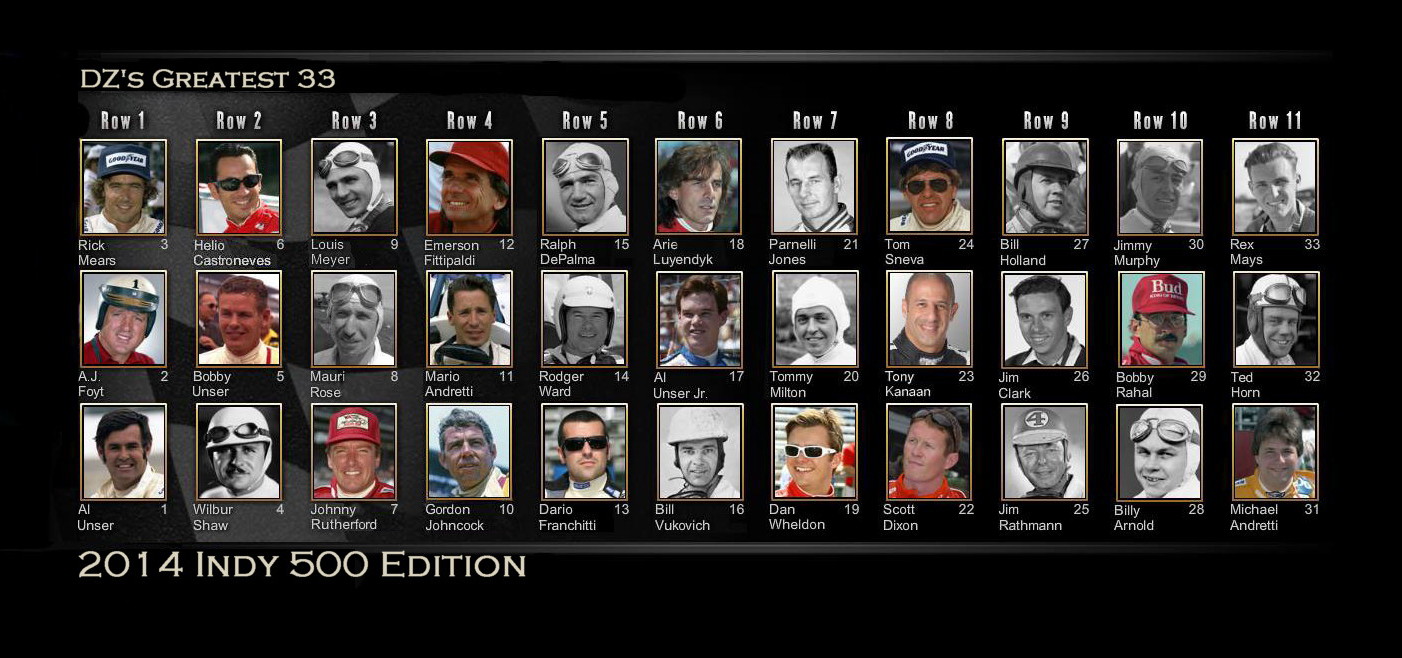
Here is my Greatest 33 following the 2014 Indy 500 results:


Rows 1 – 3:

Rows 4 – 7:

Rows 8 – 11:


And my criteria for helping select these drivers:

As you can see, emphasis is weighted heavily on winning the race, with additional consideration for Top 5 finishes, Poles won, Laps lead, and making the race. Michael Andretti, Ted Horn, and Rex Mays are the three highest rated non-winners at the expense of Buddy Lazier and Sam Hanks. 

For 2015, I am considering tinkering very slightly with the amounts of weight between these categories and also have given an intangible additional consideration for those who’ve also held track records or currently own a track record. 

I’m actually quite happy with this list although I think fair arguments could be made for other drivers in the one-win and no-win positions. This is how I choose to delineate my “Greatest” from the “merely great” or “very good”. 

What is of most importance and most exciting to me now is seeing what changes from year to year with the active drivers moving in the list. 

Will Helio, Dixon, or Kanaan, gain an additional win and move them each into the most rarefied of air in my Greatest 33? 

Can Carpenter, Marco, Hunter-Reay, Montoya, or even Lazier move into the discussion based on their results this year? 

What do you think of these cold, hard, numbers that marginalize the likes of Lloyd Ruby, Dan Gurney, Gary Bettenhausen, Jules Goux? 

These are things I enjoy pondering and makes following along consistently much more interesting. 

Let me know what you think about the legacy of The Greatest 33..


The Middle of The Road

“the middle of the road, is no private cul-de-sac…”
– Chryssie Hynde, The Pretenders

As my tens of readers may or may not have noticed, there was no post last Tuesday. Due to a much-needed and enjoyable vacation week, I elected to enjoy my day at the beach and pool rather than stuff more content of questionable quality on the internet.

I found that, even on vacation, Indycar is never far from my mind. Road-tripping for 19 hours with my family to the sunny climes of Gulf-coast Florida, allows for copious driving time and the mind will wander, although auto-racing and Indycar is naturally very close to the surface.
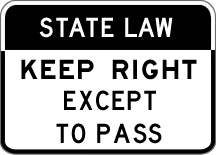
The only major lament I’d have from this trip is that, while spending a vast majority of four days driving out of the last nine, a vast majority of people simply do not know how or do not care to know how to act while driving on a major interstate highway (RANT ALERT). There is ONE very simple rule on interstates that would ease SO many traffic woes:


It was observed that a goodly many of drivers from such great states as Michigan, Ohio, and Indiana, seem to be keenly unaware of the laws of most every state in the union with regard to interstate driving. 

Perhaps they’ve not heard the cautionary words of Chryssie Hynde.


Perhaps they’re unaware of the consequences of such actions.
Perhaps they simply do not care. 

Perhaps they’re rude and unchivalrous with regard to road etiquette.
I find it quite an unseemly commentary on our society actually.

Regardless, it is in the middle of the road, where you do indeed see the darnedest things, and yes, it is no cul-de-sac. Seemingly safe and comforting to be in the middle farthest away from those scary edges of the known. Unnecessary traffic snarls and semi-close calls belie that it’s actually a treacherous place filled with danger. 

Just ask Kevin Cogan. 

Or Ryan Hunter-Reay.


I cannot say to this day, with the highest degree of certainty that Hunter-Reay or Cogan were totally to blame.  The preponderance of evidence seems weighted against them however and often the precise facts of the matter rarely count in the court of public opinion. Both did harm to their reputations as drivers and both did damage to the image of the sport to some degree.

Even the sport of Indycar itself shows a proclivity for the safety in the middle of the road with its oft-compromised decision-making and white-washing of the history of the sport.

Maybe I’ve just become more sensitive or tolerant of the realities of life. As I get older, the middle of the road isn’t seen as a narrow balancing point but has come to represent a vast grey area that lies between the narrow lines of either extreme. For a great many days of our lives it is relatively safe there, but for the increasingly binary times in which we now live, for better or worse, it has come to represent a place lacking a sense of gravitas and especially at critical moments in time.  

Rick Mears’ famous outside pass into turn one at Indy in 1991, en route to his fourth and final Indy 500 victory, was in no way considered middle of the road.  The fastest race speed he would turn that day going into one, taking the most extreme line possible with no guarantee of coming out the other side cleanly is an example of not compromising at precisely the right moment in time.  


And such is the stuff of legend.