Hello from 2010.

“Days turn to minutes and minutes to memories,

Life sweeps away the dreams we have planned.

You are young and you are the future,

so suck it up and tough it out,

and be the best you can…”

J. Mellencamp, 1985

As this Indycar fans ages, it becomes evermore disturbing just how time seems to not only pass more quickly but at an accelerating rate. Some of you may already experience this, and some soon will, but it seems no one is immune to this sensation.

Johnny Cougar, who in his evolving artistic maturity became John Mellencamp, also noted this phenomenon in several songs during and after the apogee of his career (in terms of sales). The lyric quoted above is taken from the Scarecrow album song entitled, ‘Minutes To Memories’.

I first experienced that lyric and the songs of the Scarecrow album during a time in my life that I can scarcely recall anymore – my early adulthood, aged 18, and moving away from my home, to college in Indianapolis. Painfully familiar with how my friends’ parents always took a bittersweet tone when they sang along with a similar lyric from his notable ‘Jack and Diane’ song three years prior, I was already aware that one coping mechanism is to try to remain blissfully unaware of my own impending life changes, holding onto 16 as long as I can.

Much as we all perhaps seek to maintain grasp on that frightfully short (and often easiest) portion of our life, change comes at our behest or otherwise and more often than not, different than we imagined. I’m sure Anton George would likely attest.

So too it was with the world of Indycar, ten years ago in 2010.

“TEN YEARS, MAN! Ten. Ten YEARS?! Ten years. TEN… TEN.. YEAARRRRRSSS! Ten years!” One of my favorite scenes from the movie Grosse Point Blank comes to mind immediately whenever we near an anniversary or some numerical decade involving a base-10 reflection leads to the incredulity of how quickly that time has passed by us.

On January 1 of 2010, the landscape of Indycar was a fair bit different.

  • IZOD had recently agreed to become the first title sponsor of Indycar since Northern Lights ended after 2001.
  • Tony George would resign in mid-January of 2010 from the Board of Directors of IMS, following a very long, protracted, and expensive battle with CART/ChampCar, that resulted in the absorption of that sanction and teams into the new IZOD IndyCar Series.
  • February 2nd saw the hiring of Randy Bernard as the new CEO of the Indy Racing League, the single-most prominent division of the IndyCar Series and open-wheel racing in the US.
  • Names familiar to us now populated the drivers and ownership rosters. Names like Penske, Ganassi, Andretti, Foyt, and Coyne, all owned at least one full-time entry.
  • Kanaan, Marco, RHR, Dixon, Grahamie, Sato-san, Easy Ed Carpenter, Power, and Helio all raced along the other famous names who no longer ply their trade such as; Meira, Danica, Franchitti, Bad-Ass Wilson, Wheldon, Fisher, and Briscoe inferno, and many others.
  • The schedule included 17 events with currently-familiar Indycar homes such as; St. Pete, Barber, Long Beach, Indy, Texas, Iowa, Toronto-eh, and Mid-Ohio. The venues of 2010 not on the 2020 schedule may jog some memories; Sao Paulo, Kansas, The Glen, Edmonton, Infiniyawn, Chicagoland, Kentucky, Motegi, and Homestead.
  • Honda , set to exit Indycar after 2009 was sufficiently cajoled into staying through 2011.
  • Early into an interminable 10-year and fractured TV deal, ABC/ESPN and Versus split the schedule.
  • An oval (Foyt) trophy and road/street (Andretti) trophy was awarded at the end of 2010 along with THIS newly-minted (thankfully short-lived) and spuriously-conceived ‘Flying Cocksman’ IZOD-commissioned Series Championship trophy:
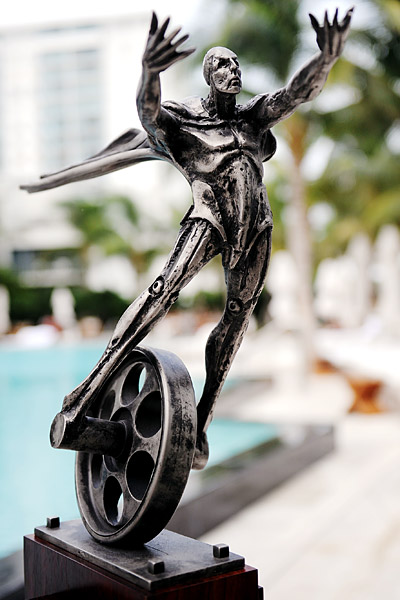
The 2010 IZOD IndyCar Series Championship Trophy

How no one has grabbed a modern OneWheel board and dressed like this trophy, no matter how ironically, to the 500, or the final race of the Indycar Championship is beyond me.

Set in motion in 2010, however, were several things which we now find more enjoyable about Indycar to this day (many of which couldn’t arrive too soon for fans):

  • New chassis development with updates and more attractive features.
  • A severe dislike of the aforementioned split TV schedule (e-NOUGH of the splits already!) which lead to a single-network-supplier TV package in 2019 (So sorey-eh to my Canadian friends though!)
  • Dedicated work toward multiple engine manufacturers and MORE POWAH!
  • A newfound enthusiasm for the sport stemming from an executive who openly-engaged the fans (somewhat to his own peril). He and the league worked to incorporate their desires into the product (much-easier it is now for fans to be heard for the TV supplier, venues, and the league than ever before). Not all data is important, but the mere act of accepting and sifting through modern consumer-input allowed a growth into a more fan-centric product as ever before, I believe.
  • Shift away from the purely traditional schedule and dates, and more toward keeping more financially-successful events on the schedule, developing continuity from there. As much as we all loved Milwaukee or Chicagoland or Kansas or The Glen, the pure fact remains that not enough paying race fans came through the doors, regardless of marketing or myriad other excuses.

In looking back at the world of Indycar in 2010, there are many familiar things, yet the sport has changed quite a bit in what doesn’t seem 10 years.

I started this blog in late-2009 and, likewise, it doesn’t seem to be that terribly long ago, yet in many ways, at 52 years old, I feel too old to be a voice of the modern Indycar fan.

In taking most of 2019 off from blogging here, I reflected on Indycar bloggers and podcasters past and present. Is there a place for me to keep some moderate/centrist/devil’s advocate/grounded thoughts and ideas ‘out there’ for Indycar and autosport fans? Is it of any value and effort in an increasingly binary society? Is examining alternative ideas and keeping a modicum of basic critical thought toward this sport something enjoyable? Is anyone already doing this and much better than I? I’ve decided to find out.

In doing so, I also relocated to my blog to this new site, which may undergo changes as I become more familiar with formatting and the like. I do not undervalue how an aesthetically pleasing site is more enjoyable, so bear with me as things become less utilitarian and more eye-friendly. I’ve also brought forward the posts from my previous site for my reference as much as anyone else’s. Some posts seem cringeworthy today, but I suppose it’s no different than looking back in an old yearbook at pictures that captured the moment with an accuracy we may now wish it hadn’t.

I’m not young, nor the future, but I’m going to suck it up, tough it out, and be the best I can.

I welcome your feedback here in the comments, via twitter @groundedeffects, or via my email groundedeffects@gmail.com, and look forward to interacting with you here or maybe even at an Indycar track in 2020. Happy New Year!

Pocono – The Other 500

(c) 2017 LAT Photographic – Abbott

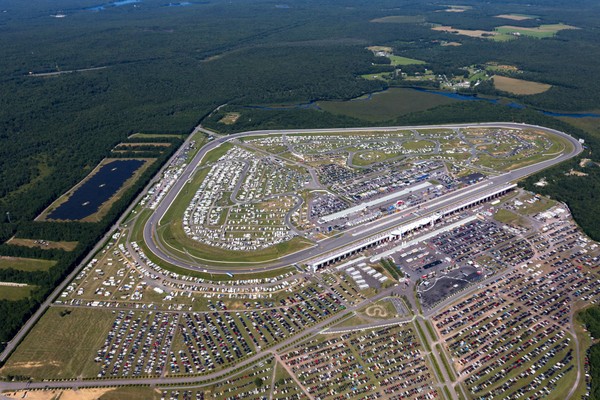
While other tracks have cheekily claimed 500 or 550 or 600 in their event titles, Pocono remains the only other true, old-school, 500-miler on the schedule. With the news that Pocono is considering signing for Indycar events beyond 2018, fans of this unique and legendary palace of speed will certainly be relieved if and when it happens.

What is it about ‘500’ that adds a certain cachet in automobile racing? As a number, it was rather basically developed over a hundred years ago to provide an “all-day” event in Indianapolis each May. Ever since, the 500-mile distance still remains a race that tests team and machine and driver more than most any other race, and most typically at storied venues like Pocono. Of course the 24-hour sports car races are much longer, but also utilize multiple drivers and crew members during their events. Those races, however, have also become more like a 24-hour sprints, rather than paced endurance races.

Maybe it’s the speeds attained and maintained during these races that add to their lore and attraction. In 2014 at Pocono, the top-10 drivers (all finishing on the lead lap) averaged over 202 miles per hour for the entire race distance. This currently stands as the fastest race by average speed for a 500-mile race in the history of Indycar.

It truly takes something special to win a 500-miler. Pocono also boasts a who’s who of Indycar legends as its winners. Among them you will find the legendary likes of Donohue, Leonard, Foyt, Rutherford, Sneva, Unser, Mears, Andretti, Rahal, Dixon, Montoya, and Power. 

In past, venues like Ontario Motor Speedway, Michigan International Speedway, and California/Fontana Speedway all hosted 500 mile events for Indycar. Aside from Indianapolis, the only 500-mile race distance venue remaining on the schedule is legendary Pocono.

Pocono stands alone in many ways.

Currently, it can list the following titles among all Indycar ovals; the farthest east, the fastest, most unusually shaped, “tricky”, widest straightaway, longest straightaway, remote, camper-welcoming, and “green” (100% solar-powered, 75% event waste stream diverting). All of those features combine for a modern Indycar fan’s delight, deserving Indycar’s support whenever possible.

(c) unknown – aerial

While some bemoan the lack of support races found in it’s current format, it’s noteworthy to remember that this is the only other 500-mile event on your Indycar calendar. If you enjoy outright speed, history, legend, majesty, scenery, camping, or any combination thereof, you will find it difficult to match the allure of Pocono on the Indycar schedule.

Let’s hope Indycar and Pocono can secure this storied and worthy venue and the 500-mile race distance for years to come. 

Vive La Livery!

The visual sense and how we react to the stimulii is one of a human’s most basal conditions. Especially in this modern era of media, we are bombarded with images appealing, repulsive, and everything in between.


McDonald’s, for example, is among the most prolific in their study of marketplace and more specifically telling perhaps is their devotion via millions of dollars in research over decades to the very topic of visual appeal to ensure the utmost in terms of attractiveness to their products and experience. They are often deemed highly successful in exploiting our own senses for their gain.

For the world of autosport, the fan experience is predicated largely on the sensual perceptions of sight, sound, smell, and, to a lesser degree, touch. I’m not aware that I’ve ever tasted Indycars in action, but I can’t say that I can rule it out either simply because I’ve never put my tongue on one, but several moments have left me with mouth agape.

Most fans who have experienced autosport in person will generally refer to the torrent of sensations related to it that drew them to the sport initially. I would concur. It is also such that it seems difficult to explain to someone who has never been.

Despite however great the IMS radio network has been at creating pictures in the mind’s eye of the action, nothing will replace the experience of being at the track. It’s what makes a day at the track so enjoyable for many – the incredible experience one has that engages most all senses to the maximum.

A very distant second to being at the track is perhaps radio for audible reception or TV coverage for whom the visual is primary. Visual input is perhaps the strongest factor in determining how most receive the experience of autosport.

Something as simple as the static design of the car, and colors and lettering upon it, generate much attention and appreciation by fans. It is the primary effective experience by which the fan can receive other information aside from the racing action itself. With the depth of sensory imprinting on the race fan, the livery is perhaps one of the most critical intersections of art and commerce.

Even in the earliest days of autosport, attention was paid to varying degrees about the visual aspect of the machine and how it relates to those who experience it in person. With the advent of color photographic film, the real beauty of the cars could be displayed to the masses who were not in attendance.

The word “livery” originates in French (“livree”) and was used in reference to a person or thing who was required or given something (a badge, for example) to visually symbolise a connection (or loyalty/ownership). It’s evolved into the automobile age through racing (car’s color and lettering scheme) and we still appreciate them today. It’s oft said, “Beauty is in the eye of the beholder”, but I also like to more objectively rate the effectiveness of a livery by how quickly I can recall the sponsors associated. I have some major product recall due only to the liveries of cars decades ago. Pennzoil is one fine example of effective association of color and design to me.

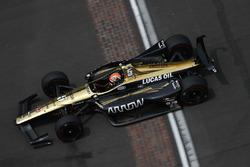
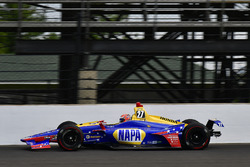
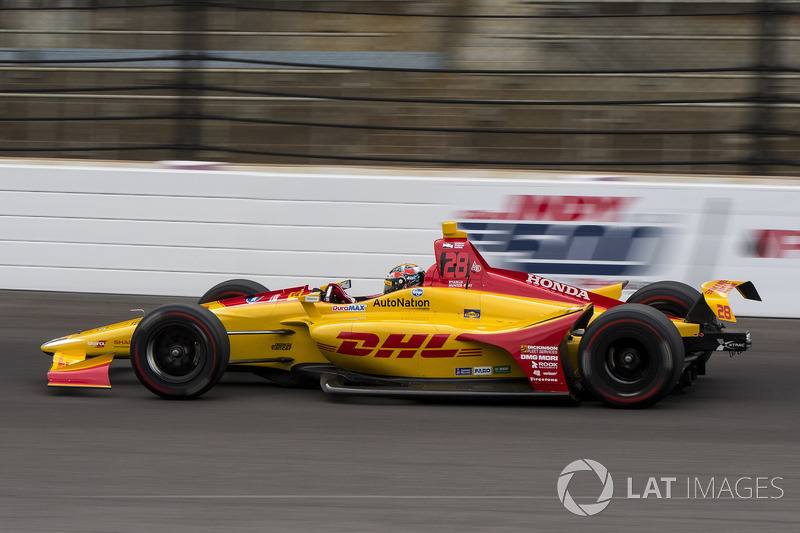
Having spent some time watching Indycar practices for the 500, here are the first five sponsors from this year’s Indy 500 entries to date that I can quickly recall at this moment: Arrow, Napa, DHL, Pennzoil, USAF.

Now here are their liveries:


all pictures (c) 2018, LAT Images and their photographic artists
Ask me again tomorrow and the answer likely would swap a couple of others not shown here.

Livery design is a competition within the competition of auto racing I enjoy to watch as well, especially in the build-up to the racing action. Those who can capture the eye likely have a better chance of name retention. Granted, some of the above liveries are a result, as noted above, of many years of consistency and clarity in design, or simplicity of name, but that is also to their credit.

Which liveries appeal to you?

Which ones from this year’s field can you recall within seconds? 

Which ones from years ago do you still quickly recall today?

If you let your brain spit them out without much thought, you might be surprised at what comes first…


W(h)ither The Oval

(c) 2018, Leavitt, LAT

Upon reading this article by Robin Miller for RACER today, I’ve again returned to my thoughts and this blog in considering the existence of ovals on the Indycar schedule.

On a nearly per-oval-event basis, most longtime and/or devoted Indycar fans offer thoughts on the waning existence and popularity of the “meat and potato” ovals for which there seems little opportunity for change to satisfy the cries for more on the schedule.  

(c) 2018, Mark J. Rebilas, USA Today

Indycar has billed itself as having the most versatile menu of drivers in motorsport. Marketing slogans are often a wry exercise in embellishment, but one would be hard pressed to find the top 20 drivers of any racing series more adept at racing not only multiple styles of tracks, but also multiple types of vehicles than found in the Indycar Series of this decade.

Great drivers can drive most anything it seems, but the current depth of talent found here is worthy of comparison to the legendary greats who raced in the golden era of Indycar (I place at approximately 1960-1979). In 2015 I noted how we seem to have a habit of missing just how truly excellent the current generation of Indycar driver is, but that is another matter. The recent venues of Indycar are of which we discuss today.

Phoenix is another example of an historic Indycar oval venue, rich in golden-era legend, that apparently lacks present-day popularity if judged by crowd size and ticket sales. The same can be said for the likes of Milwaukee, Trenton, Ontario, and Michigan.

Pocono is a golden-era exception whose efforts toward modern-day Indycar have been welcome and notable, but even this grandly unique and historic Indycar speedway doesn’t begin to fill its staggering capacity for seated or camping customers.

The ovals associated with the IRL era (1996-2008) such as 
Walt Disney World, Nazareth, Nashville, Kansas, Homestead, Richmond, Kentucky, Charlotte, Atlanta, Michigan, New Hampshire, Las Vegas, Dover, and Chicagoland also failed multiple times to be an attraction to the ticket-buying public. Numerous factors have conspired at different times to cease those Indycar relationships, but often it seemed that in the waning years of an Indycar event at these venues, the dedicated promotion was reduced to nearly nothing instead of increased. 

(c) 2017 Gateway Motorsports Park

Gateway Motorsports Park in St. Louis is the most recent oval addition (from the IRL oval era) and they’ve impressed beyond most expectations with their commitment and execution for the return of Indycars in 2017. They have exhibited a motivated desire to see Indycar succeed by lavishing the local markets promoting their race which worked to astounding results.

I might contend, as I have for many years, that the need for an event to succeed at the ticket office, drives the effort by the track to promote the race accordingly. With few exceptions, the tracks noted above are either defunct for Indycar racing, demolished, or owned by International Speedway Corporation (a subsidiary of the NASCAR ownership), or Speedway Motorsports Incorporated (a company who hosts several of the major NASCAR events during their season). Despite Miller’s desire to see Indycar return to the few remaining legendary tracks of the golden era, often to the extent that he rarely finds fault with ISC/SMI Indycar race promotion efforts, but I think I see their efforts in a different light. 

While one could argue that none of those venues want to host a failed event, I’ve always felt that the ownership with such close ties to their primary client  (NASCAR), has little impetus to spend to the degree equal to a NASCAR event required to make it a success.

Fans who’ve joined this sport in the last 20 years, often have little knowledge of the significance or attraction of the golden-era or even IRL-era tracks for newer fans. When seen with an unbiased eye, the oval racing was in actuality almost always either boring processionals or horrifically dangerous pack-races, neither of which entertained in quite the manner that pleased fans of both sides and the larger audience.

In the modern era of versatility as a selling-point, it would seem preferable that the recipe of scheduling include no preponderance of any particular flavor, but a skilled blending of several. For this, I applaud the current Indycar management – especially Mark Miles and Jay Frye – for working tirelessly to continue to perfect the blend of available seasonings and present a well-balanced and flavorful schedule of events.

It also has long been a mystery to me why, when the opportunities arose, to possibly purchase a few venues along the way, none were nabbed. It makes perfect sense to seal a few locales into the schedule through ownership just as NASCAR has done in a more substantial way, but there’s little doubt the Hulman and Company coffers to do so were less flush with cash than ISC’s, but there remained a few that possibly could be available for the taking. 


Nashville, Pikes Peak International Raceway, Gateway, Rockingham, and Iowa among others have all traded hands at some point in the last 10 years and IMS/Indycar would’ve benefited from having at least a couple of those. 

Essentially, to lose Phoenix would be a shame as it holds an historic place as a unique track within the larger Indycar pantheon, but mainly only for those whose value as an Indycar fan is tied to the nostalgia of bygone oval-based eras. 
Losing Phoenix shouldn’t be viewed as a deal-breaker, nor ultimately is the loss of any venue whose bread is so heavily buttered with NASCAR dollars. 

With IMS forever the crown jewel of the series, Gateway quickly cementing their place in the schedule, Texas the oft-prickly stalwart, Pocono committed, and Iowa still hanging on, the mix of ovals for 2018 and beyond should be viewed as an appropriately well-balanced blend on the schedule, each of which to be celebrated in their own way, and as a group, properly testing all manner of driving ability. 

Certainly, this also represents a fair sample of the types of ovals Indycar has raced upon in the last 40 years and I will continue to rate higher the actions of serious commitment and dedication to Indycar than any lip-service toward fading historic value. 


Adjectively Speaking

During ABC’s TV Broadcast of the Indycar race at St. Pete yesterday, Eddie Cheever made his beloved and dramatic ‘one-word’ prognostication for the day’s event – “chaos”. In hindsight, one cannot really argue much with that as the definition accounts for some of the action on track yesterday. 

I had several adjectives that described how I was feeling leading up to, during, and after the very racy 2018 Indycar season opener; hopeful, eager, surprised, anxious, giddy, amazed, empathetic, and hopeful.

Hopefulness sprang out of the months (and, in truth, years) of waiting for a new and exciting Indycar to hit the track. One that justly rewards driver skill and management and also manages to entice a viewer with classically attractive aesthetics.

Eagerness began in earnest with news of testing in January and February. Positive and even glowing reports on the new chassis “raciness” and the good initial function of the potential safety/windscreen flushed my racing cheeks with positivity heading into the new season.  Dare I dream to believe that Indycar once again could be the amazingly entertaining (and even sexy) racing product so many fans knew it could? Could spring signal a rebirth of positivity, excitement, and optimism for one of my favorite sports?

With the twist of fate brought about by moisture on the track during qualifying for the first race of the new season, nothing but surprise could describe most fans’ reactions to the qualifying results. The final six in the Firestone Fast Six shootout contained three rookies, three veterans, and for the first time that I could recall in many years, six different teams in the top six spots.  One of those rookies – Jordan King, driving for Ed Carpenter Racing – even set a new track record in the first round of qualifying.

Surprise gave way to the anxious feelings when the green flag is about to fall at St. Pete and especially when there are three rookies up front leading this burgeoning pack of hungry Indycar racers, all eager for those first true racing laps of the new season. Safe to say that I always fear turn one at St. Pete because the symbolism of the long-runway-straight reminds me of the stark off-season, long and slow to build in momentum until the green reminds us we’re full-throttle into a hard and opportunistic right-hand 90 degree turn, begging for the most aggressive of lines, before the tires are even warmed.  What happens in that first turn of the first race of the new season often signals what to expect. Especially after the abysmally long wait, to finally have an Indycar that this fan could proudly hold up as the exemplary essence of this type of racing, I still remained anxious for the possible carnage of turn one at the Alfred Whitted Airport race circuit.

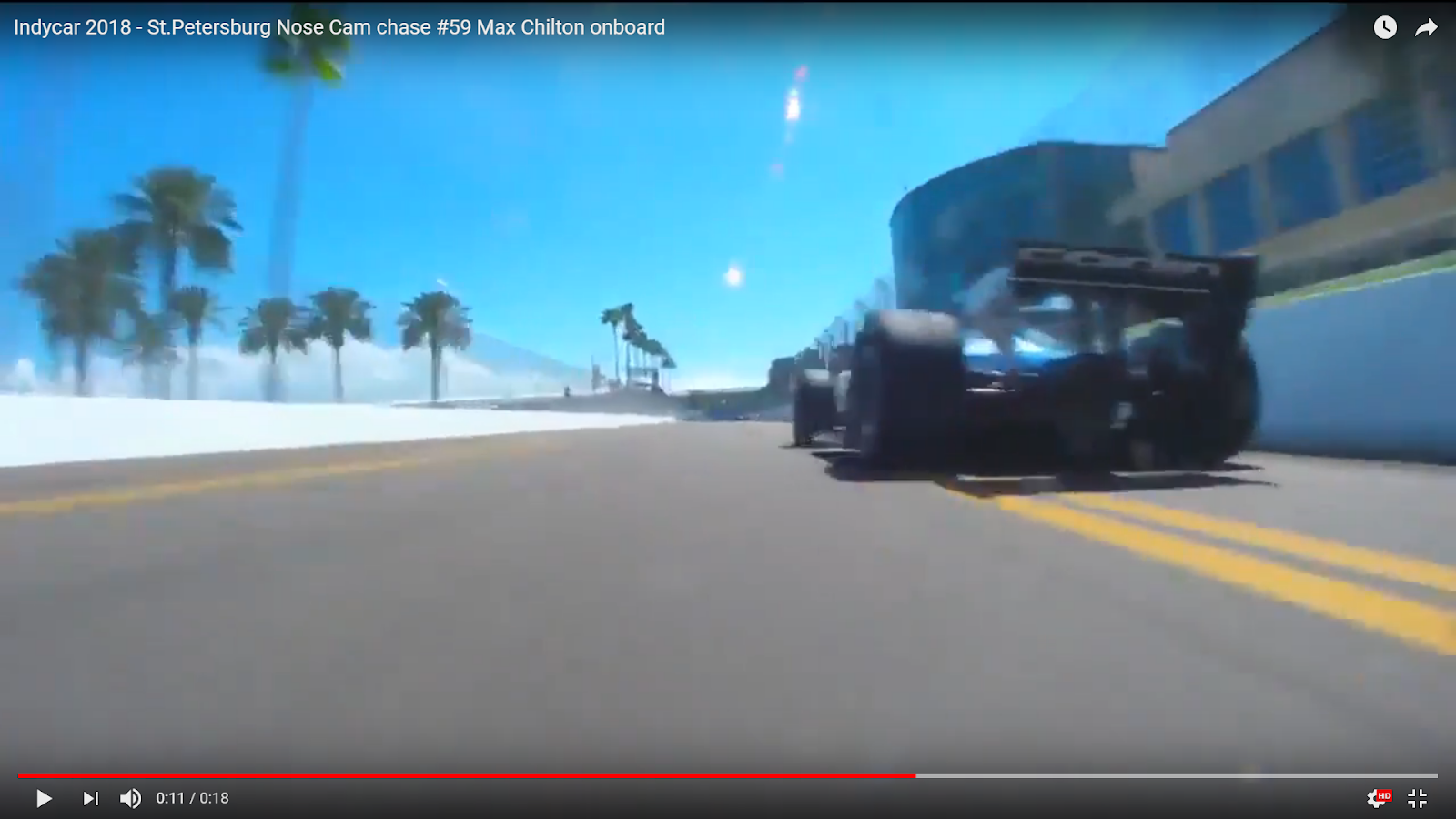
With some tenuous and unsurprisingly eventful laps in the book, the race never failed to hold my attention.  I was able to eagerly concentrate on as much racing as the TV coverage would show, despite the expected drone of uninspired and anemic commentary. I would add the caveat that Allen Bestwick gets a pass from me for his work because his job as ringleader of the clownlike coverage is subject to so many things beyond his control, including the bland color commentary. Expecting as much, I tried to focus all of my attention on the visual information we were given and I was liking what I was seeing, especially with the new and revised camera views which added a great deal of excitement to the broadcast. This feeling that had come over me, I hadn’t felt in far too long a time. I was giddy with excitement that the racing had given us.


(nose-camera image via Indycar YouTube screen capture)

With the movements of drivers up and down the scoring due to mostly all racing-related variables, I was amazed at the skill of the driving and the passing we were seeing.  All except at the front, where rookie Robert Wickens had shown us why he was so highly rated by Schmidt Peterson Motorsports.  He was building a lead over several veteran drivers. How could you not like the fortitude on display?  I was genuinely amazed at how this race was playing out and especially for this driver, so new to Indycars, scarcely putting a wheel wrong all day, deservedly leading in a manner that only exemplified his considerable skill and his team’s preparation. This guy, and this team deserved to win.

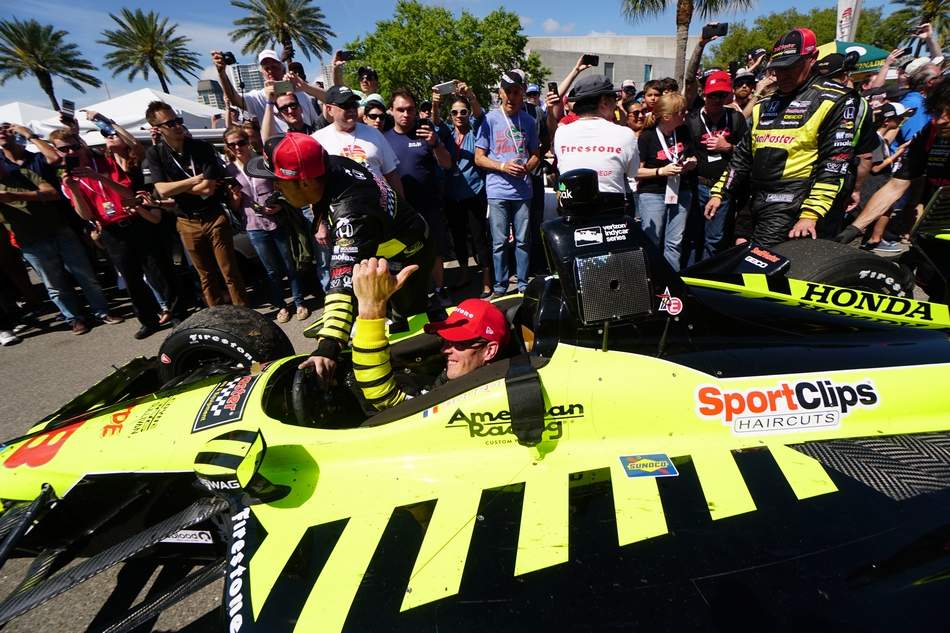
As we watched the late-race dramas unfold, a race fan of any seasoning would’ve known we were in for a seriously tense finish. It did not fail in that regard and unfortunately Mr. Wickens was the recipient of a ‘racing incident’ that in my view could’ve been avoided and not sent him spinning into the wall after completing, what was to that point, as near-perfect a race as one could have. I would consider myself a fan of Alexander Rossi, but I certainly empathized more with Wickens. He deserved to be on the top step of the podium without question but, as we know so well, racing doesn’t always reward the best on that day. So too could I empathize with Sebastien Bourdais’s victory as it emotionally and fully closed a circle of high and low events he experienced in the previous 365 days. From his race win here a year ago, to the horrific crash at Indy qualifying, to the rehabilitation of his mind and body, and now a return to victory circle at his adoptive hometown and site of his previous Indycar win, it was a result worthy of celebration. 

(c) 2018, Luis Santana, Tampa Bay Times

In all, yesterday’s race was one of the best races I can recall at St. Pete and I am beyond impatient to see the next race. I think that’s a sign of the hopefulness I am feeling about each practice session, each qualifying day, and each race this season.  


Catching Up with Portland International Raceway

The addition of Portland International Raceway to the 2018 Indycar calendar was one that came as some surprise to me and forces me to connect with the sport’s past in a new way during this off-season.

This track originally existed on the Indycar calendar at a time when I was often preoccupied with the matters of adolescence and young adulthood, and also during the time of year (June) when still satiated of racing from the Indy 500.

Early-summers for me meant being fully into my golfing practice schedule (for which I dedicated the most of my time, playing competitively in high school and college). Summer weekends of the 1980s through mid-1990s rarely found me in front of a TV in the mid-afternoon.


As a result, I cannot say that I ever watched the Grand Prix of Portland live on TV. Once the track stayed with the CART/ChampCar calendar in 1996-2007, I felt no significant reason to prioritize its viewing.  Now I find myself, decades later, researching the history of the race and wanting to become familiar with the track layout. In doing so, I found a very interesting history of the track’s emergence into being. For some more dedicated than myself to Indycar during those years, this will probably be old news, but for fans newer to the Portland International Raceway and the Grand Prix of Portland, these are the bits I found of most interest:


1. Portland International Raceway was built on the site of a former small city.
Vanport, Oregon was essentially washed from existence during the Memorial Day weekend of 1948, by the massive flooding of the Columbia River.  The existence of Vanport, built on a low-lying area between Portland, Oregon and neighboring Vancouver Washington to the north (hence the portmanteau of Vanport), began as a wartime public housing project conceived, designed, and completed in less than a year (1942) to house an influx of workers involved with the local shipbuilding industry.  At it’s peak, over 42,000 people inhabited the residential city, the second largest in the State of Oregon.

In late-spring 1948, after a heavy, late-season snowfall followed by torrential seasonal rains, the snowpack and rainfall across the Columbia River watershed (from as far away as Montana and British Columbia), coverged into the Columbia River, pushing the oncoming water to over the dike system developed to protect Vanport. The entire area was flooded by as much as 20 feet of flowing water, releasing the housing and structures from their meager foundations.  With much of Vanport’s population transient workers, the decision was made to not rebuild the public housing and the young residential city ceased to be.  


(l – Vanport City, r – current day PIR)

The City of Portland annexed the area in 1960 and began contemplating how to use what little remained – the city streets of Vanport. Alas, as racing was a burgeoning post-war sport and, when combined with the Portland Rose Festival, automobile and motorcycle racing became staples of those grounds.

As the danger of remaining building foundations and precious little protection for drivers and fans existed, fulfilling the requests by racing sanctions saw the reconstruction of the area into a fully-dedicated drag-racing and road course facility, now what we see as Portland International Raceway.  Trans-Am (SCCA sanction) racing in the mid-1970s brought attention to the track by those in charge of CART.  Some of the remaining visible Vanport city features have been highlighted in yellow in the photo above.


2. Longtime Sponsor – G. I. Joe’s was not related to the toy of the same name.
With the decision to bring Indycars to PIR for the 1984 season, Stroh’s Beer was the first title sponsor to come on board for two years. Following thereafter, local military surplus-turned-sporting goods chain – G. I. Joe’s – began it’s run of being primary or co-primary sponsor of the race for 20 of the next 21 years. G. I. Joe’s was originally a military surplus store which grew into a local chain and expanded offerings to include outdoor gear, automotive parts, and sporting goods as military surplus dwindled.

Joe’s, as it came to be known following an equity buyout, suffered in the mid-2000s, fell into bankruptcy proceedings in 2007, and was liquidated in 2009.  The event’s return this year is simply listed as ‘The Grand Prix of Portland’.

3. Justin Wilson holds the track record.
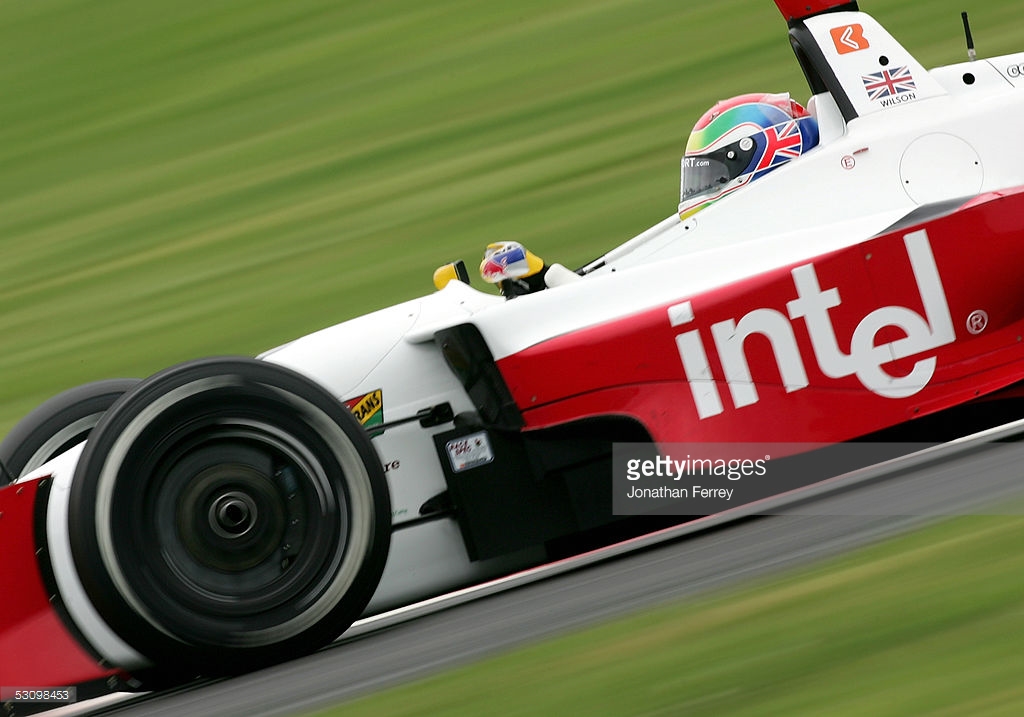
Set during qualifications, Justin Wilson set the current track time record of 57.597 for one lap of the current 1.964 mile layout, driving the RuSport entry in 2005. His time equates to an average speed of 122.756 mph. Previous layouts and measurements in the history of the event show a quicker time and the slightest of faster average speeds, but those layouts are not the current one in use today.


(Justin Wilson on a qualifying run at PIR, 2005)

4. Pole and Race Winners are a ‘Who’s Who’ of American Open-Wheel racing.
If the history of this Indycar race says anything, it’s that only a titan of the sport will win at Portland.  Multiple Pole Winners include; Danny Sullivan and Emerson Fittipaldi, 3 times, and Justin Wilson twice.  Currently active driver Sebastien Bourdais is the defending Champion (2007). Past Race winners listed following;
1984 – Al Unser, Jr.,
1985, 1986 – Mario Andretti,
1987 – Bobby Rahal,
1988 – Danny Sullivan,
1989 – Emerson Fittipaldi,
1990, 1991, 1992 – Michael Andretti,
1993 – E. Fittipaldi,
1994, 1995 – A. Unser Jr.,
1996 – Alex Zanardi,
1997 – Mark Blundell
1998 – A. Zanardi,
1999, 2000 – Gil De Ferran,
2001 – Max Papis,
2002 – Cristiano Da Matta,
2003 – Adrian Fernandez,
2004 – Sebastien Bourdais,
2005 – C. Da Matta,
2006 – A.J. Allmendinger,
2007 – S. Bourdais

I look forward to delving into more of this race’s history and watching older race footage if available online. At the very least, I’ll be watching what I expect to be another great race and for the first time in my history, live.

Dear Aerokits, Thanks for Everything. Sincerely, This Old Fan

As we draw to a close this latest of Indycar seasons, we also dedicate to posterity what may be labelled as the ‘Aerokit Era’.

I see it as the last remnant of the Randy Bernard era or the second half of the DW12 era (2012 through 2014) pushed on by Derrick Walker, and spanning from 2015 through 2017.

How it will be viewed is a matter for time to decide. Marshall Pruett has a fantastic article in Racer Magazine that reviews the Aerokit era from a more technical point of view including the feedback of several drivers during that era.

Some may judge it harshly for the on-track product, possibly labelled as a step back from to the previous and surprisingly-racy DW-12 spec chassis era. Expenses related to development, expenses related to repairs, extensive clean-ups times from in-race contact, ineffectiveness of abating contact via the rear bumper-pods, detrimental effects on trailing cars’ handling, and even serious questions of safety for both driver and race fan from flying debris and flying cars when not retained or pointed in the prescribed direction, were all unintended consequences and valid concerns which needed addressed only weeks into the practical application of the aerokits. Maybe those who judged them harshly were right. History will also show they weren’t a significant “needle-mover” with fans or TV ratings.

What I had hoped for and saw from this era, however, is something less practical and more widely symbolic – a significant turning point in American open-wheel racing.  The DW12/aerokit era represented a new way of thinking about many things, one of which was a perceived shift in sport-to-fan relations.

In an age of unprecedented access and information to the mass public, what remained of the dwindling legion of AOWR fans had multiple platforms to make their voices heard, often and loudly. Demands for progress in the sport on many fronts were frequent.  None perhaps more frequent or symbolic than the car itself. While the relative cost to own and race an eight-year-old spec chassis design may have been more owner-friendly, it also wasn’t providing the fans or sponsors with any confidence that the sport was moving in a positive direction.

Count me among those, so when the earthquake of leadership at Hulman and Company brought in a fan-focused and visible leader in Randy Bernard, there was finally reason for fans to embrace a bit of optimism for progress. Perhaps quite emblematic of his tenure, the Bernard era that begat the Aerokit was also not without a raft of unintended consequences.

On a larger scale though, I still deem it to be an overall success as the tumult from what became the Aerokit era, was also a seismic shift away from the stale and somewhat rudimentary past, providing Indycar fans, sponsors, and teams a fresh glimmer of hope for the future.

While only two manufacturers committed to the aerokit era, what was discovered through their competition and experience formed the foundation for what could be one of the most impressive overall eras for safety, performance, driving, racing, and watching Indycars we’ve ever seen.  So much so that teams, drivers, and sponsors in the staid and classist Formula 1 series, have cause to take a serious look at what is going on in Indycar.

Much of the credit goes to the Mark Miles era of leadership and more specifically to the appointed work of Jay Frye and Bill Pappas in taking the lessons of the aerokit era, amplifying the positives, reducing the negatives, and developing the new spec chassis for 2018 and beyond. Many great fan-produced liveries also attest to, and are emblematic of, the enthusiastic reception this new car has received.  Dare I say I cannot wait for February 2018 already?

When weighed against past eras, I am very optimistic that this era we approach, the IR18, with the all-around amount of technology, safety, performance, and aesthetic appeal, coupled with one of the greatest generations of drivers, Indycar should see a revival of sorts. All of this would not have been possible, however, without the engaging experiment that started with the Randy Bernard leadership and ended with the Aerokit era.

Never a fan of the concept of spec racing, I see the oncoming Indycar era as what might represent the pinnacle or ‘best possible solution’ of spec racing in its most overall sense. The next step (and final piece), in my opinion, should include more variety of power plant configurations (and manufacturers). If this proves to be true, the coming era of Indycar may very well be at the forefront of the best auto-racing on the planet.  


Lead, Follow, or Get Out of the Way

There is an axiom that floats about the business world, “people will tell you what they want, if you just listen to them”. The most successful salespersons and businesses shut up and listen, examine that information, and then figure out how to best provide it.

Today the Formula 1 drivers Association also took their concerns to F1 via an open letter to the ownership and directors of that sport, expressing a desire to see better stewardship of the sport with regard to long-term vision and plan. It all sounded so familiar. I even mentally inserted “Indycar” anywhere the words “F1” appeared with very little difference in consistency with issues known in Indycar for decades.

I thought to myself, ‘here’s yet another example of how Indycar has lead the world of autosport by 10 to 20 years’. We’ve been dealing with a sport whose organization can be characterized by the public as insular, short-sighted, lacking vision, and reactive since the late 1970s and especially so since the mid-1990s.

The good news for Indycar is, that is a bit farther up the road in dealing with a business ‘contraction’ than F1 or even NASCAR. The bad news is that the progress has come in fits and starts and is always much slower than the customer would like to see. It also comes at a time when it competes with ever-more diversions for the public, never less.

So how is it then, that a company can be perceived to be so aloof, especially when the lifeblood of its existence (sponsorship and broadcasting rights monies), is based on having eyeballs and ears on the product?

As we draw ever-nearer to the incredibly massive landmark 100th Indianapolis 500 Mile Race, we again are reminded so vividly of a sport that has been extremely adept at holding up it’s super-speedway, golden era (early 1960s to mid-1970s) as the hallmark of it’s existence and implying a parallel with the modern day. Those who have lived long enough to have seen those days with our own eyes and ears, always bristle at the comparison and rightly so. The sport today resembles so little of that Golden Era. The fact that we STILL gush more about the innovation of 1961 Cooper Climax, or the 1967 Paxton STP turbine, a full 50 years later than we do about the one that won just 11 months ago, or even two weeks ago, I’ve always found to be quite telling.

F1 has also been good at holding itself up as the pinnacle for newest and most innovative technologies for decades. It some ways it actually has, but as for the management of the sport, it’s still shows a heritage with the Draconian-types of the industrial age. 

At one time, the production auto industry used autosport as a working laboratory for development of better machinery to be translated into the passenger vehicle. Now it appears a new day is dawning in the automotive industry where technology is rapidly changing the mobility vehicle and how we engage with it. Likewise, there is an opportunity to examine those changes and see how autosport can incorporate them into their future.   


I’m reminded of that famous phrase, uttered in front of a shiny, new ‘K-car’ c. 1981.

I’m not sure if he originated the phrase, but I recall quite clearly for well over 30 years now, Lee Iacocca, then President of Chrysler, making that quote famous via his television ads for the ‘new Chrysler Motor Company’ – “In this business, you lead, follow, or get out of the way.” 

At the time, the car company was attempting to emerge from a terrible recession and bring a new philosophy, optimism, and ambition to the fore. It was a successful campaign in many ways although it didn’t solve all of the ills that plagued the company or the industry as a whole.

Autosport is still a reflection of that industry in many ways, especially by being tied so closely to the worldwide auto industry for obvious reasons, but I think the future will hold that the sport who was able to show the ability to listen to all voices of interest (not merely a few select ones), establish a forward-thinking and relevant vision, a clear plan to achieve it, and provide the product that people will demand in the future, will be the most successful. 

Even at it’s relative nadir, Indycar can still be a player in that game. Once the celebrations, revelry, and nostalgia of the landmark 100th Indy 500 end, I believe strongly that a new era must begin. One that is bold, exciting, invigorating, and isn’t afraid to be something innovative.


“Fear can hold you prisoner, hope can set you free” is the promotional tagline from one my favorite movies, “The Shawshank Redemption”, which was adapted from Stephen King’s Different Seasons group of novellas. Rita Hayworth and the Shawshank Redemption represents the season of Spring and is also subtitled, “Hope Springs Eternal”.

The character of Ellis “Red” Redding in that story cautions the reader (through a dialogue with the optimistic protagonist Andy Dufresne) that “Hope is a dangerous thing. Hope can drive a man insane”. Later, however, in reply, the character of Andy Dufresne states, “Hope is a good thing, maybe the best of things, and no good thing ever dies”.


I still hold out hope that Indycar can be the pinnacle of modern autosport it was.

I hope I’ll be able to make it to that day.

I hope to be there and shake my Indycar friends’ hands. 

I hope that Indycar will be as incredible as it has been in my dreams.

I hope.


Not Good Enough


It doesn’t seem so very long ago when we were all left in stunned disbelief following the death of Dan Wheldon, October 16, 2011.


Maybe it’s because it hasn’t been that long really. 

Now resigned to the terrible result of another all too fateful moment on Sunday, I finally had to take a moment away from my work duties this morning to read what I wrote in the hours (of shock and disgust with the sport) and days (of ‘Indycar family’ and hope) following Wheldon’s death. 

Seeing the television footage of the helicopter rising from its mid-track perch at Pocono on Sunday was an all too familiar scene and one that left me suspended between disbelief, despair, and hope. 

I told my kids this morning about Justin dying before they left for school. Certainly far from ideal timing but I also I didn’t want them to not hear it from me. 

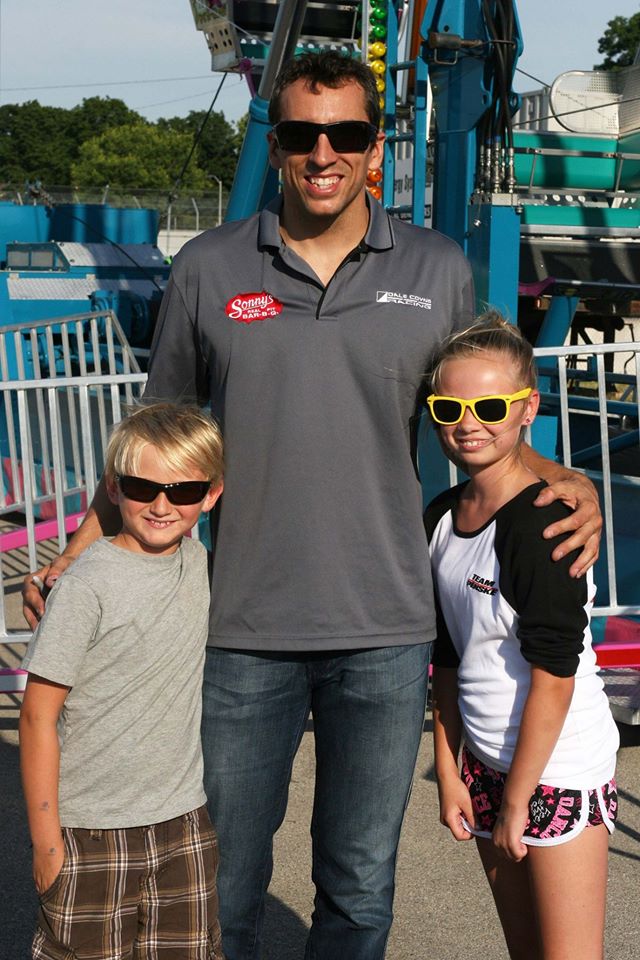
Nick, Justin, Ellie. Milwaukee 2012.
Photo: (c) Lynne Zehr
My daughter is a casual fan who could name several drivers and recognize a few by face. My son has a bit of deeper interest and knows most every car and driver visually. In the case of Justin Wilson, he represents a rare moment that they both shared with him in Milwaukee back in 2012. 

He had just finished a TV report of his riding the Milwaukee Indyfest ferris wheel with a young fan and was heading back to the paddock. We just happened to be walking nearby and asked for a quick photo opportunity with him which he so graciously, and so ridiculously-commonly, obliged. 

That was over three years ago and while my kids have grown so much when compared to the picture, they both remember this moment quite vividly and fondly. Both were saddened to hear the news I had to share with them this morning. 

I was equally sad to have to deliver it.

Having just surpassed my recent “Gurney Eagle/Jerry Karl/Foyt’s third entry” birthday, each year seems to bring more energy into my brain for more existential pondering – “what, if any, is the purpose and meaning of life?”

You may have also read my recent post with the same question bent specifically toward the sport of Indycar. Having little remaining hope that Indycar will ever be any sort of genuine ‘innovative and working future-thought laboratory’ for auto manufacturers as I’d dream, I have finally come to grips that this sport is set-up primarily as an entertainment vehicle which sells thrills and tradition and nostalgia in direct support of the Indianapolis 500 and the benefit of those who own the event and property.

“Duh.” might be your response. 

Fair enough, but I bought in early and heavily into the ideals found in automotive innovation found in the golden years of auto-racing (c. early-1960s to mid-1980s). Giving up on that ideal has been difficult for sure as it represents, to me, all that is good about people – the unfailing human desire to achieve and progress – working together to improve the things in our lives and the world around us.

That flicker of optimism found in human nature as reflected in the form of automotive racing has finally been extinguished for me. So what is left is simply a sport as entertainment vehicle. 

What is left is simply not good enough. 

This sport, as we are all too-well aware, is horrifically brutal. There are moments of thrilling performance to be sure, but when things go wrong, it seems it is always in spectacular fashion. I’ve written before about the ‘the long dark thread’ woven into the fabric of autosport. Sunday was evidence that thread is long and continuous. 

And so here we are again.

Another death. 

Another widowed family. 

Another horrible event in a long list of horrible events. 

It seems that only numerous, and somewhat random factors, align to produce these darkest of events which often leave us with nothing else to ponder but “why?” Could every single death of every single racing driver and fan have been prevented somehow? Of course, but it’s always that strange alignment of wrong thing, wrong place, wrong time. 

In pursuit of something so uncommonly amazing, such as landing a human on the moon, the risks are significant and great and their achievement stands as incredible historical human events. People lined up to be selected for those ridiculously dangerous roles because their desire was so great to risk their very essence to be a part of that history.

For me, Indycars racing around tracks on a sunny, summer Sunday afternoon for the benefit of thousands watching in person or on broadcast are not of such gravitas. Likewise nor do I think the similar risk of life is worth the paltry sums of either glory or riches we have today in autosport, and Indycar specifically.

Therefore, I simply find no good, remaining excuse you can give me why the safety of the competitors (and crews and fans) isn’t paramount anymore. You may want to argue with me whether safety is or isn’t paramount, but following and understanding what has happened in this sport over the last 40 years, I’m of the informed opinion that cost-containment, not safety, is at the forefront. That isn’t to say that the current cars aren’t amazing in how they protect drivers and fans, but that safety needs to be at the forefront of autosport design now. 

The time for making only reactionary improvements in safety has long passed. These people aren’t sound-barrier or moonshot pilots, they’re highly skilled drivers of cars for entertainment purposes. I have no desire to see people on either side of the fence get maimed or killed for a paltry bit of entertainment. 

What we have is simply not good enough. 

Justin Wilson knew all too well the risks involved. By most all accounts he also was a very thoughtful and genuine person who spoke often of his concerns for the safety of fans and drivers alike. We know there are significant risks that have existed for several years and still need to be addressed as evidenced by the most recent injuries and fatalities from cockpit intrusion in autosport, and especially over the last seven years. I call for this issue to be addressed now via development of the full enclosure of the cockpit from all manner of intrusions. End of story. It will take nothing away from the sport and it’s enjoyment. 

Not just incrementally better but BEST driver protection should be the new hallmark.

No amount of tradition, nostalgia, or perception of danger is worth this. No excuse you can give me for not immediately pursuing, testing, and incorporating designs fully-enclosed cockpits in Indycar is acceptable. Anything short of this is not acceptable and I’ll go one further and propose that NO MORE Indycar racing should occur after Sonoma until this is properly done. 

What we have is simply not good enough.

I’m telling everyone in the positions of power and rule over the sport of Indycar – I will not watch people die anymore for the sake of mere entertainment. 

No reason you can give me, or Susie Wheldon or Julia Wilson or whomever the next is to be widowed by this brutal sport, is good enough.


What we have today is simply not good enough.

 
Right now, this sport is simply not good enough to go on.


Perception Is Everything

“There are things known,

and things unknown, 
and in between 
are the doors of perception”
– Aldous Huxley

With a relatively late-in-the-day 4-hour drive home from the Milwaukee Mile Sunday night, and my fully-tired 11-year-old son asleep in the co-pilot’s seat, I had some extended solitude with which to consider my very enjoyable weekend in West Allis, Wisconsin. 

Typically, I’ll stay off Twitter while at a race because I am a big advocate of simply filling your senses with the many inputs received during a race.  This beautiful Sunday, however, tweeting while watching the racing as moments allowed, came much more easily than in other recent events (Indy 500). While doing so, following others’ comments via twitter confirmed for me my belief that the intake of the product in-person and for those not on-site is different and that those differences are quite marked.  I also noted that even at various locations in this relatively small venue, the experience is different. 

Reflecting during my drive I was left with many positives over those 36 hours, but also two crucial items that I believe strongly Indycar must concern themselves with: what the product is and how to best manage its perception (or reception). Since I’ve already written about the existential ennui of Indycar multiple times, I’m going to take aim at how it’s perceived.

During practice and qualifying, I took a seat near the end of the front straight in the front row, just 15 feet away from the cars at speed. 179 mph trap speeds at a range of 15 feet or less is close to mind-blowing, and especially so when watching them negotiate a seemingly-impossible 180-degree, flat-arc change of direction over the next five seconds. 

Much as you have, I’ve seen in-car camera views of them going upwards of 235 mph, but being in-person and so close, even at 180, is the best way to really sense how fast they’re going. For the race, my seats were near the same point of the straight but within 3 rows of the top. Huge difference in perception! 50′ above and approximately 75′ away from those cars (see pic – P = Practice, R = Race). The cars look fairly fast yet fairly benign from that location.


Imagine going from standing on a sidewalk proximity to a 7th floor window view across a four-lane street. Sure the overall view is better, it simply isn’t the same experience in any regard.  I’ve always been an advocate of sitting as closely as possible as it seems in direct correlation with how amazing the sensation of the cars speed is.  

Herein lies my point – Indycar MUST be able to give as many fans as possible this experience. Even if not everyone could sit in Row 1 and see them speeding by, to have this in practice gives a new perspective on just how fast these cars are, even at “just 180 mph”. 

The perception that the racing isn’t very thrilling unless masses of cars are heaped on top of each other goes away quite rapidly when you see just one of these cars ripping by you that closely at speed. You can quite easily see the difficulty of their proposition and to then consider a tightly bunched pack is, in fact, lunacy.

Getting more fans closer access needs to be a priority even in the age of moving fans farther away from the danger. It’s imperative that the fan see just how amazing these cars are and as closely as possible. Finding a way to also get that sensation communicated via a camera to a remote viewer is a challenge even-bigger although the in-car cameras begin to approach it. 


I’ve yet to see the TV coverage from this weekend but I’m sure I’ll be quite amazed at how poorly the sensation of speed comes across. Other forms of racing may be suited for the types of camera angles we’ve seen for decades, but Indycar would do itself much credit to develop an entirely new way of receiving the product for those not in attendance and also figuring out a way to emphasize how being in-person is the best way to see it.

I can’t even remember how many times I’ve said, “TV doesn’t do it justice”.  Perhaps no other sport I’ve attended reflects this sentiment quite as much.

Blow up the decades-old methods of visually presenting Indycars at speed from high above and a wide-angles.  

Give us a view and a sensation that is totally unique and amazing.


Editor’s Note: I’ll have some continuing thoughts on this subject as a guest blogger over at Oilpressure.com tomorrow for the Brainstorming Series.