Godspeed

Just a few days ago, on a recent music-related trip to Nashville, Tennessee, I was also able to devote some impromptu time for what I will loquaciously describe as a ‘Friday PM Indycar Fan and Blogging Commiseration Summit’. 

In the maelstrom of the final hours before the 2013 Indy 500, I had several regretfully much-too-brief interactions during the pre-race tweet-up and picture this past May.  When I officially knew we were coming to ‘Nashvegas’ for a few days, I knew I needed to look up our good Indycar friend, George. George Phillips (of Oilpressure Blog fame and @oilpressureblog on Twitter) and his lovely wife Susan (aka @chiapet58) and I gathered together only to share some time getting to know each other. I doubt they’d mind if I revealed that the evening was full of good conversation and laughs on a great many subjects, Indycar included. 

Of all the things I’ve experienced over the last several years in the world of Indycar as experienced over the internet, my most positive experiences come from the direct social interaction with people whom I’ve only previously known via a digital environment. This includes fans, drivers, and racing industry people alike. This Friday PM was no exception.

After our ‘tweetup-of-3’ and after much discussion on the messages we put out in the universe via our blogs and twitter, I was left with the overriding feeling that, of all the problems Indycar has to overcome just to survive, the fans are not one of them. 

I also felt, as the same themes keep appearing in my writing and truly I have nothing new to say, and, as I’ve been threatening for several posts now, this is a good time to set the blog aside for a while. 

In summation, as I have written many a tome on the subject of Indycar, my primary goal (and the reason for the naming of Grounded Effects) was to produce thought-provoking and engaging commentaries for the fans of Indycar. I still feel many of the thoughts here have value in the near- and long-term for Indycar fans so please feel free to visit the “Museum” of the Grounded Effects blog… don’t cost nothin’.

For your ease of future reference, below is a compendium with green listings among the most read, and the orange listings among the most read and personal favorites of mine, the links for which are found under the ‘Museum’ heading on the upper-right column of this blog. 

If you wish, please also follow down to the bottom for my final thoughts. 


2009
Sep.   
I’m going to blog about Indycar.
How I got started following Indycar, part 1.
Oct.
How I got started following Indycar, part 2.
Favorite Indycars, part 1 – ’79 Chaparral.
          Nov.
Indycar thoughts for the future.
Favorite Indycars, part 2 – ‘65 Lotus.
          Dec.
An Indy 500 trip for $365 (aka The Dollar a day plan).
Fave Indycars, part 3 – ’70 PJ Colt.
Please don’t change/mess up the start of the Indy 500.
2010
          Jan.
Tony G is out – Open letter to Hulman IMS ownership.
          Feb.
The Hallowed Grounds in winter.
Carb Day concert band suggestions.
100 days to Indy – Indy trip planning.
          Mar.
Fortune favors the bold – new car/engine ideas.
Season opener – Sao Paulo race review.
Faux Carb Day concert band announcement.
          Apr.
Disparity in racing is OK.
Simple Indycar math.
Celebrating some good news and more Indycar math.
          May
May = Indy for me.
500 Qualy predictions.
Last minute Indy trip stuff/prediction recap.
          July
D-day ICONIC preview.
          Sep.
Reviving the fading mystique of Indy ramble.
          Oct.
End of Season thoughts, part 1 – Dario is a legend, small crowds and TV.
End of Season thoughts, part 2 – Indycar is a niche sport, but devoted fanbase.
          Nov.
Post-season withdrawals, Pagoda shuttered, Chevy’s back, TK out of ride.
Thanksgiving and more Indycar math.
2011
          Jan.
Blog review.
Blog visual refresher.
Whither Sam Hornish.
Essence of NASCAR vs Indycar racing/competition.
          Feb.
American auto companies thoughts.
          Mar.
Indycar misses formula for future.
Whom should Randy Bernard trust?
Favorite Indycars, part 4 – ’85 March Cosworth ‘spin and win’.
          Apr.
Indycar parody lyrics – Jay Penske – Lawyers, Guns, and Money.
          May
Greatest 33 thoughts.
500 Qualy predictions.
Qualy predictions recap, race preview and prediction.
          Jun.
Race and predictions review.
Explaining Indycar to non-fans.
          Aug.
Predictions for the future of Indycar – Pain.
Fave Engines of Indy, part 1 – ’60s Ford V8 (sounds).
          Sep.
Why NASCAR drives won’t race the Indycar World Challenge.
Funky Cars of Indy, part 1 – Yunick’s ’64 Hurst Floor-shifter Spcl.
          Oct.
Indycar’s missing character – the car.
Post-Las Vegas/questioning my Indycar.
Dealing w post-Vegas grief.
          Nov.
Indycar Slang.
          Dec.

Looking to 2012 – Carb Day band ideas.

2012
          Jan.
Goofy graphical thoughts.
Missing Dick Simon.
          Feb.
Fans demand better Indycar coverage online.
Laughing at the new F1 cars – Platypus fever.
Zip-Line fever/Ideas for the 500.
Fave engines of Indy, part 2 – The Offy (sounds).
          Mar.
Pre-season cautionary thoughts.
Indycar Parody lyrics – Pippa Mann – Pippa Nation.
Equinox – new season.
St. Pete expectations/self-mantra: post-Wheldon.
          Apr.
Writing contrition.
The Greatest 33 and Indycar nerdery cont’d.
          May
Indycon Level 4 and my origins redux.
Jay Penske redux and diatribe on Indycar’s direction.
My rambling Indy 500 trip memories, 2004, part 1 – a new beginning.
My rambling Indy 500 trip memories, 2004, part 2 – cont’d.
My rambling Indy 500 trip memories, 2004, part 3 – final.
Indy 500 qualy predictions.
          Jun.
Milwaukee Indyfest trip and an energy revelation.
          Jul.
Drama as an asset to Indycar, not a distraction.
Humorous end-of-race alternatives to Green-White-Checkers.
          Sep.
Indycar needs some Gangnam Style.
Now THAT’S a season (review).
          Oct.
Days of Reflection (Wheldon and life).
Escapism in the off-season.
          Dec.
Left adrift as an Indycar fan – no more apologism.
2013
          Feb.
Post-Superbowl, waiting for Indycar.
Indycar and my iPod shuffle (a noir narrative).
          Mar.
Crystal Ballin’ – 2013, beyond… die spec racing.
          Apr.
Nostalgia as a false pain-relief remedy.
          May
One last plea for Indycar change.
          Jul.
Pocono – an on-site review for IndycarUK.
          Aug.
Should there be an end of the Hulman reign over Indycar?
          Sep.   
Final Rites – Grounded Effects Blog Recap.
Epilogue
I have been a fan of varying degrees of Indycar for nearly four decades and have come to the following conclusions with regard to the sport:
1. The Indy 500 is still truly a worldwide showcase event.
2. Building a viable series around the Indy 500 has proven to be folly. Aside from the 500, it has been and essentially still is a niche (300,000 followers/20,000 in person) sport and will remain so until a philosophical shift of what Indycar is supposed to be occurs, if ever.
3. For the sport of Indycar (or any autosport) to thrive and grow in the next 20 years, it MUST allow for an open, flexible, and agile set of rules and platform in which real innovation, creativeness, forward-thinking, and ingenuity are welcomed as the norm. Something akin to a ‘formula libre’ Indycar can thrive. 
4. I believe no other option exists for Indycar but to change radically. If not, it will continue the slow degradation and devaluation death march we’ve seen for nearly 20 years. Change is well overdue. 
5. I give Indycar in its current state through the 2016 season. It must either have a plan for radical change in place or it will be done. The current ‘timeline’ recently set by Walker and Miles is not a plan which will cause Indycar to survive beyond 2016.
6. We fans are never the problem, RATHER, we’re the solution, and don’t let anyone tell you otherwise. Until Indycar figures out what fans truly want and supplies what we demand, there is no long-term viability of the sport.

It is truly as simple as basic economics:
– The fans are consumers. We have the power of our money to support the things we demand. 
– Discretionary spending will continue to be reduced as the economy continues to polarize and eliminate the middle-class.
– The ONLY reason any professional sport (product) exists, ultimately, is to fill a demand by the fans (consumer). 
– Supply of product in and of itself does not create demand.
– Consumers will respond positively when you supply something they demand.
– The supplier who truly listens, who cares, and aims to provide the best possible product to meet or exceed the consumer expectations will be the one who ultimately survives.
– For auto-racing to be a viable sport, supply MUST ONLY follow demand.
– For Indycar to merely have the potential to survive, it must provide a product in much greater demand (at least 3 times the current demand in both TV and on-location markets), all other things being equal.
– You fans are the consumers. You have the power to demand, but it’s up to suppliers to fill that demand. 
– I believe without question that demand will be filled. 

By whom is the Billion-Dollar answer.
“Whosoever desires constant success,
must change his conduct with the times.”
-Niccolo Machiavelli


Best wishes and Godspeed to you all!

It Is Finished

and after receiving the tweet, DZ said, “it is finished”, 
bowed his head and gave up his spirit


Based on a brief interaction with long-time Indycar tweeter, and even longer-time Indycar fan @stevewittich, I was harshly snapped from my mid/late-season Indycar and ambivalent blogging funk to post my thoughts today.

Here’s that interaction…


Here’s what I thought immediately following.. 

The time has come for Hulman/IMS to divest 
itself totally from the business of running Indycar. 


I understand fully the Hulman Companies position and myopic desire to ‘hold’ the property of Indycar, especially through May 2016 (the 100th Race) but I honestly believe a strong and significant argument can be made that the previous 19 years of history shows a constant decline of, and inability in, tending to the business of the top level of American Open Wheel Racing.  

All the while, IMS as a facility and property has done just fine thank you very much, and to me, the stark contrast between the entities of IMS and Indycar over the last 19 years indicates that the management of those two entities under the current roof is not tenable in any form.  I’m thrilled as a native Hoosier and longtime fan of the hallowed grounds that IMS as a landmark racing facility has improved so steadily and mightily, but the product that is Indycar is not in the hands of the people who can make it grow.  The time is now for Hulman and Company to release Indycar into the hands of people with a vested interest, ability, and desire to make it grow, without the distraction of associated and conflicting interests.

This got me thinking about the fair bit I’ve been reading about Dan Andersen and his acquisition of the entire Mazda Road To Indy ladder series. Dear Dan, if you are listening, it’s me, DZ…

I’m sure his plate is overflowing with all the challenging goodness that F2000, Star Mazda, and now Indy Lights currently hold, but if there’s anyway you could see fit to be involved in obtaining Indycar from its current overseers, I think we’d really have something of major value, structure, form, and energy to begin a terrific new jumping-off point for the next chapter of Indycar. 

I’d like to write a ‘thank-you’ note something like this around my 50th birthday, approximately 4 years from today…

Dear Mr. Andersen,

It is with great happiness that I celebrate my 50th year of existence this week and also my 40th year as a fan of Indycar.  I think it goes without saying just what an immense job you have done with our great sport of American Open Wheel Racing and I speak for many who hold you in the highest regard.  

All the options created by the diversity and technology you’ve harnessed in the new chassis and motor rules have made Indycar not just interesting to the manufacturers, but vital to gaining the rabid interest of fans and sponsors, the likes of which we haven’t seen since the ’80s.

Now, to have completely obtained and reshaped the Indycar ladder and positioned it for tremendous growth as you have, I am ever-hopeful the sport we all love will continue to grow and prosper as it has under your guidance for future generations. 

Many thanks Dan! You’ve given this 50-year-old fan the best Indycar present he could ask for.

And now, my blog must rest again. 

To sleep, perchance to dream…

Pocono – An ‘On The Grounds’ Review…

(this is a copy of the track review post I did for my friends over at Indycar UK, please check them out)

Prologue:
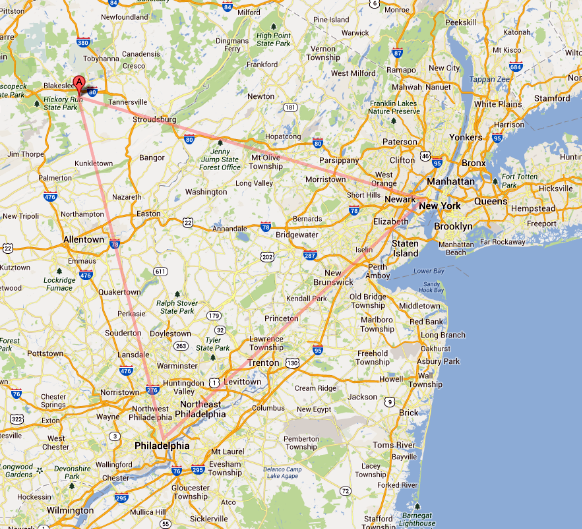
Pocono is set in the pastoral rolling hills of the eastern Pennsylvania, approximately 2 hours drive and triangulated nearly equidistant from the mega-metropolitan centers of New York City and Philadelphia.  For me however, this was a journey of 24 years and 9 hours..
The Tricky Triangle Triangulated
Growing up and living in the mid-west of the US has been quite convenient when one is an Indycar fan. Of course Indianapolis Motor Speedway, despite being 135 miles away, would be considered my home Indycar track, but several prominent and historic Indycar ovals are only a partial day’s drive away. Michigan, Milwaukee, Chicagoland, Kentucky, from 2 to 4.5 hours by car ride, and I’ve seen Indycars race at each of those. My list of places I’ve never seen Indycars race, however, is longer than of those I have. Of course the great and defunct tracks (such as Langhorne, Trenton, Ontario, and Nazareth) I will never see, but my list was gladly reduced by one this past weekend.
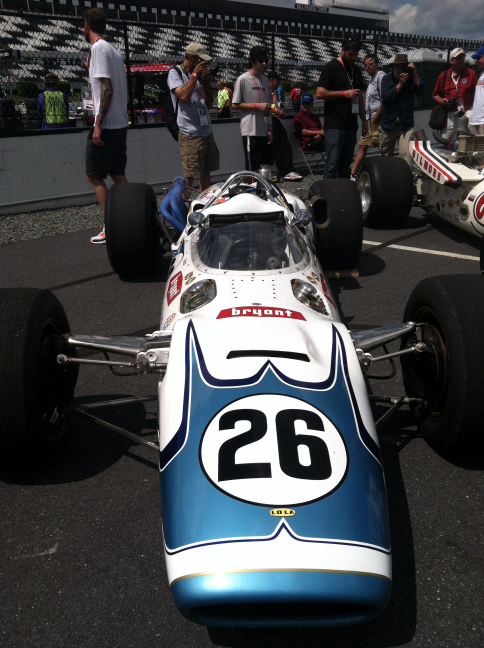
Speaking of Rodger Ward – his 1966 Lola was on display in the paddock.
It is difficult for me not add the word ‘historic’ before using the name Pocono Raceway because of its stature in Indycar’s timeline. With design input from Indycar great Rodger Ward, a most unique triangular oval was built and first was host to Indycars in 1971. After many great and legendary races over the years, some intense bickering between ownership of the track and the then-current CART sanction regarding safety and track condition finally lead to Indycars not returning to historic Pocono in 1989. Now, 23 years beyond, in the fall of 2012, and after $Millions in renovations underway, Indycar CEO Randy Bernard and Pocono family ownership lead by Brandon Igdalsky struck a deal to put this fan-favorite track back on the schedule for 2013 and beyond, while also reviving the Triple Crown for Indycar.  Having never seen our beloved Indycars racing there in the prior 24 years at this great track, I knew the 9 hours drive to the track was still a “can’t miss” opportunity. 

The Track: 
Its deviously different 3 corners have confounded drivers and engineers since inception which is why it is a favorite of mine. Long before the 1.5 mile, high-banked and dreary cookie-cutter ovals featured prominently on the US racing landscape, track owners seemed to want to use their imaginations to create a unique racing experience for teams, drivers, and fans alike. Pocono is a great example of this. The region around the track property is hilly and wooded and somewhat remote from cities which lends a bit of serenity to an otherwise tempestuous locale. Its chosen setting also makes track access by car less than ideal, mass-transit non-existent, and most hotel inventories over 20 miles away but any fan worth their salt will gladly realize the extra hour either arriving earlier or waiting to enter the property is well-worth it when the green flag flies.  Having never seen any previous iterations, I found the permanent fan amenitites modest, welcoming, and well-thought out.  The extra personnel from cheery ticket-takers to the bathroom attendants that keep the facilities tidy and well-stocked help to ensure the fan feels well-regarded by the track. The premium Paddock Club seating is the central (seen on TV as the black and white checkered color) of the Main (and only) Grandstand in which each ticketed seat is a plastic, molded chair seat and back which makes a multiple hour event more tolerable than the remaining aluminum bleachers. 

The Patron-Race Experience: 
Making such a long trek, I wanted to be sure to give myself some time to experience the garages and fan village, so I purchased the $20 Saturday General Admission (required for track access) to catch practice, qualifying, vintage cars lap, and the Indy Lights race. I also opted to add the $20 Paddock Pass for the infield garage access Saturday only.  The Paddock Pass was well worth it for me to be able to chat with crew or drivers between practice sessions, grab a picture or an autograph, or just to see the garage happenings up-close.
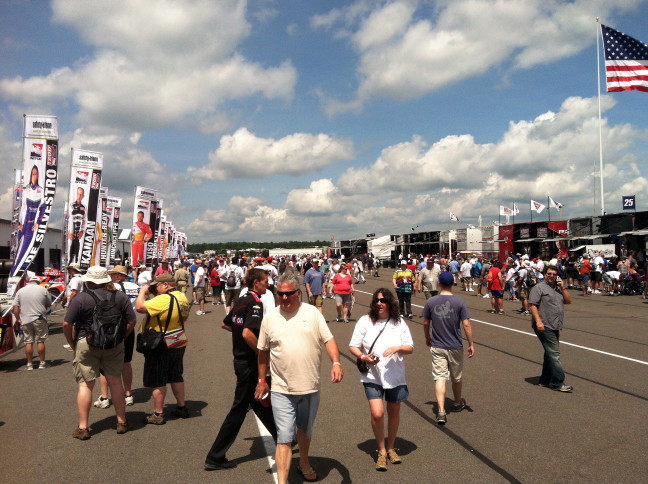
Hundreds of fans took advantage of the Saturday Paddock Pass and the great access it provides.
You never know whom you might meet in the Paddock…
Sunday’s raceday ticket placed us one section before the Start/Finish line approximately halfway up which is fairly close to my ideal location. I have found that my Indycar viewing is enhanced by being as close as possible to the track as opposed to the common thought for NASCAR fans to sit as high as possible.  I enjoy the increased sensation of Indycar speeds being lower and closer to the racing action. There are also the uppermost levels of enclosed or shaded sections in the long main grandstand which provide premium service and amenities for a premium price. All told my Saturday GA ticket ($20), Paddock Pass ($20), and Terrace Platinum level seat ($75) set me back a very reasonable $115 total for nearly unlimited access and a great vantage point for the race. Parking at the track is free, and the camping area fees also look to be fairly priced. 

The view from Section NB, Row 24 – approximately halfway up the grandstand
Fans can bring a modestly-sized cooler into the track stocked with food and beverages in non-glass bottles or cans provided it meets with the track’s size restrictions. Generous since the food and drink for sale is priced at a premium typical of a sporting event. 

Exiting following the race was a fairly typical 2-hour wait so we spent some of that time taking in the post-race awards and festivities, walking about the grandstand reviewing other vantage points, buying souvenirs (anything referencing this year’s race was sold-out prior to the end of the race), an passing time with a futbol in the grassy lot. Once exiting traffic seemed to be freed up, we made our way to the interstate and back to our hotel in Stroudsburg for the evening. 

For international fans traveling to the US for this race, I imagine several advantages in seeing the Pocono race: 1. the proximity to NYC or Philly for better prices on airplane service;   2. the relative bargain prices for lodging; 3. the historic nature of the oval. 4. The simple dedication to fans’ enjoyment by the ownership. For those reasons and also including getting to see ‘the fastest, most versatile drivers on the planet’, Pocono is a good destination for International Indycar fans if Indy has already been crossed off their lists.

Summary:
I can say without doubt that, of all the tracks that share both Indycar and NASCAR dates, I’ve never felt as welcomed as I was at Pocono Raceway. The amenities are good and I will easily consider this race again next year, most likely with more race fans in tow.

Every New Beginning Comes From Some Other Beginning’s End

(This post was written on the last day of April, 2013 and, after 2 days of reflection and consideration, was posted)

Tomorrow represents the figurative upswing of momentum and acceleration in Indycar toward the Memorial Day weekend classic and what I still believe is the single greatest of all auto races, The Indianapolis 500. 

Before the clock strikes midnight and May begins, however, I take this remaining time in April and mark my final day of unvarnished opinion of the current state of Indycar until further notice. There is precious little to say that hasn’t already been said by myself or others if one bothers to read and, as my blog is not monetized (requiring steady and popular content), I choose to not add unnecessary noise… after today.  I plan to post in the future with most everything being nostalgic bits from the past I find worth savoring and sharing.

Today will be a summation of my thoughts on various subjects regarding the current state of Indycar. If you disagree vehemently with my opinions today, be assured you won’t see them rehashed in the future, and likewise, if you agree with some or all of what I’ve said, bookmark it for future reference, but I won’t continue to preach to the choir.

Preamble – Noting that I have no personal, first-hand experience on the inner workings of Indycar, Indycar teams, racecraft, race engineering, or race event promotion, except for what I’ve experienced from the end customer’s (fan’s) perspective since my early exposures as a kid in the mid-1970s, my writing is based in observations that attempt at best to be even-handed from my volume of experience as a fan, as information to used for the betterment of the sport, if possible.

Past – I doubt anyone will argue with the thought that the essence of Indycar (as also with many other autosports) has changed immensely over the last 50 years. Since 1911, as a standalone event, and later with a related racing series growing up around it (Midget/Sprint/Championship Cars), the Indy 500 and the Speedway has always garnered the most attention in the world of open-wheel racing. 

Initially, as a working laboratory for the automotive industry, IMS and the Indianapolis 500 evolved during the 1930s – 1950s from oddity to grandiose public sporting event with worldwide fame.  Many people paid money for the opportunity to see something they haven’t before. Most likely what they were paying to see (or actually saw) was a combination of competitive auto technology, amazing speeds, celebratory outings, sensory-overloading race action, and some even watching the perilous dance done by drivers with death. Out of this, the drivers who managed to survive and somehow even win races, became American folk legends. The drivers who won frequently became legends and icons of automotive sport. The general public swooned.

As traits from the past changed, gone are the days of competitive technologies, speeds that amaze, and, at Indy, the significant threat of horrific death. New traits emerged – tightly-regulated, limited-cost competition, a 20-year plateau in racing speeds, and the level of daring tempered with the likelihood of severe injury or death reduced significantly. Most of this evolution was absolutely necessary and needed on a permanent basis. Fairly sanitized, now people primarily come to the 500 out of tradition, to celebrate an annual memory, or to simply be at a world-class sporting event. 

Present – Today’s Indycar has an inherent dichotomy of appreciation between the popular and savage past and the evolved and refined present. The gap in these divergent viewpoints has only been widened over time, but I believe the best of both are needed to survive. Today’s reality is that lagging ticket sales and anemic TV ratings indicate a product that isn’t nearly as popular as it once was. Indycar as a business exists somewhere closer to Hunger Games than salad days. 

As recently evidenced, the associated sponsor exposure dollars that follow ratings, ticket sales, and client entertainment don’t stay around out of tradition for very long, therefore we have precious little time for reconciliation to produce a better future.

Future – Can there be a solution that satisfies all constituents? I believe so and in my view, clearly understanding and providing what people want or expect to see from your product is the key to it thriving.  The only question of importance then becomes, “what do people want or expect to see from Indycar”. In answering that question, the key to best securing a future will be found.  So often here the temptation is to look to the past, to the salad days, and replicate that today. Clearly if it were that simple, nothing need have changed before and the current problems would not exist so that argument is fallacious.  Also tempting is to copy the closest, most-currently successful model but will that also translate to the audience of Indycar?  Again likely not or there would have not already been a differentiation in product existing. 

It is my opinion, as a fan for nearly 40 years, the enduring essence of Indycar from inception, hallmarked throughout it’s most popular days, and recalled into the present can be summed in one word – innovation.

Innovation can be defined as ‘the introduction of something new’. It is a very broad term, but also one with much appeal in (and some might say it is synonymous with) this country. The very essence of this country is tied to innovation – from something as broad as bringing a new form of government into the world to the most minuscule of modern products for living. Improving things and methods is a rather optimistic view in my opinion in that people work and desire to see improvement for present and future generations.

Innovation in Indycar can be symbolized by the very vehicle itself. Autosport already exists in many forms with numerous sorts of rules and competition but by giving the public truly innovative and amazing vehicles and technology to witness and can’t find anywhere else, will you be able to capture the imagination of a nation of people for whom innovation is essential. 

How can Indycar use this national raison d’être for its own benefit seems rather easy. Of course the devil is always in the details, but without a more broad, unified vision and direction, the details become fiendish distractions that waste the time and energy of those engaged in the business. Only with a unified vision for the sport can an opportunity for its future be assured. 

I implore all those involved charged with the sport and business of Indycar to use that essence of what made this country to your own benefit.  With innovation as the escalator to greater altitudes, don’t be content to simply ride, but boldly climb with a purpose and direction.Remake this thing into the image of what made this country, the facility of IMS, and the Indianapolis 500, famous. Without the survival of the sport as a whole, no more can there be an Indianapolis 500, an Indianapolis Motor Speedway.

Make it something with which people and businesses want to associate. Make it a sport that captures the imagination and interest of generations of people. 

I challenge you, overseers of the sport of Indycar, to boldly remake this endeavor into THE pre-eminent form of autosport in the world. 

I believe it can be done.

Be bold. You need to believe it can be done.

If you do not, the game is already over.

Indycar, My iPod, and Moz (a noir narrative)


On the shiny precipice of a new Indycar season and, in following the News of the Indycar world through February 15, I find myself again wondering, 


“What in the actual hell is going on?”

OK, ok… o….  (deep, cleansing breath)…..  k… 

Been here before, I can manage it, just need to take a moment, go for a walk.
Escape into some music, to chill… 


     (grabs iPod, dons headphones) 

Let’s hit Shuffle and see what comes up… 

     (surprised, knowing the amount of 80’s 
      metal/punk/wave is on the ‘pod..) 

OH! OK, perfect. Some nice, Jamaican-influenced pop? Johnny Nash it is…

     (presses play)

I can see clearly now, 
the rain is gone.
I can see all obstacles in my way.
Dammit. It’s not working.. 

     (I begin rewriting lyrics in my head)

NOT gone are the dark clouds which had me blind.
It’s a depressingly dark, dark Indycar day.


I can see clearly, that my affinity for parody lyrics and Indycar during Seasonal Affective Disorder isn’t going to be helpful..

     (hits Shuffle…The Smiths – How Soon Is Now?)

Oh, sweet! Early-80s, right in my wheelhouse.. 
I love this song and the 80s recalls a much shinier day in Indycar… 

     (play)

YESSSSS, thank you Johnny Marr for the great reverb/modulated guitar intro…

“I am the son, and the heir, 
of a shyness that is criminally vulgar.
I am the son, and the heir, 
of nothing in particular..”

You shut your mouth, how can you say
I go about things the wrong way,
I am human and I need to be loved
just like everybody else does.”


Hmpf. Comically apropo and all too representative of much of Indycar. 
Also not at all helping me get out of this funk, but let’s ride it out to the end of the song…

“When you say it’s gonna happen now, 
when exactly do you mean?
See, I’ve already waited too long
and all my hope is gone…”

Sonovabitch.

     (shakes head, perturbed, hits Shuffle again)
     (ironically, the algorithm pulls another Smiths tune..)

“I was happy in a haze of a drunken hour
but heaven knows I miserable now..


     (looks skyward, hands out in a ‘WTF was that?’ pose)

“In my life, 
why do I give valuable time,
to people who don’t care if I 
live or I die?”


Clearly, the universe is trying to tell me something.. to help me perhaps…


Almighty hell. Who am I to argue?

     (stops walking, stops iPod, 
      removes headphones, turns around)


I feel like going home and blogging some Indycar predictions for 2014…


Right after I listen to Rage Against the Machine… on 11.


"So whadda we do now? …We wait"


The Superbowl not 24 hours old, Indycar fans who populate the Twitterverse almost immediately set about lamenting the amount of time we still have to wait for the 2013 Indycar season to start. 

This reminds me a bit of people (mostly younger, some old enough to know better) who choke down Thanksgiving dinner, speed through valued family time, and wait outside stores to be granted prime ‘Black Friday’ access. I prefer to sit back, wait until mid-December to go cut a fresh tree and decorate it before I go out and begin shopping. Just seems a more natural progression, allowing my enthusiasm to not be stretched to the limit.

So, while I can appreciate the eagerness to begin Indycar anew for 2013, I’m just not quite about to lament yet. I say, “Relaaaax people, there’s too much that must come first.”

Perhaps it is because I’m getting older (sometimes a week seems like three days) and my patience grows with every year, but I prefer that my spring builds up annually, traditionally, and quite steadily around the following events:

1. The NCAA basketball tournament (mid-March to early-April),
2. The Masters ‘gawf toonamint’ (to use the ‘Hootie Johnson’ accent, mid-April),
3. The Kentucky Derby (early May), 
4. The Indianapolis 500 (mid-late May).

It is clear for most sports fans to see that there is MUCH beloved and long-standing tradition in those sporting events and I wouldn’t have it any other way. To fall in-line and march steadily through spring with those grand events is quite comforting (as our good friend George over at Oilpressure.com could most certainly attest). 

So, with apologies to all the über-obsessive Indycar acolytes, my personal clock will only allow the Indycar season to begin in earnest with the 500. Everything else prior, I consider a bonus. With this approach I find myself able to put the near-manic desire for open-wheel engine roars aside until May, leaving myself pleasantly surprised when the Sebring test pops up or the haulers load into St. Pete.

Meanwhile, y’all sit tight until late-March. As I noted back in October, I think the off-season is a GREAT time to bone-up on your Indycar history and maybe never so easy as to play some trivia to pass the time. 

Follow me on Twitter @groundedeffects and you’ll see my (usually-) regular Indycar Trivia question (follow hashtag #DZsIndycarTrivia) which comes out approximately at Noon EST weekdays with the answer to follow approximately 1pm. No money, no prizes, just some Indycar fun over the lunch-hour and possibly some Twitterverse glory should you get an answer right! 

Ol’ Jeff Spicoli had it right while he was learnin’ about Cuba, havin’ some food..’, and certainly there’s nothing wrong with a little feast on our time. So instead of Cuban history, learn some Indycar history in the process.

Indycar Fan Adrift for 40 Days and 40 Nights

With an innate sense of purpose, I’ve refused to post anything regarding the firing of Randy Bernard. Most of you have already heard my initial viewpoint via Twitter anyway (“I’m DONE with constantly being taken for a ride down a dark alley by Indycar”).

Now 40 days on, and hopefully with the shock of the dismissal largely over, I wanted to fully assess what is going on with Indycar before I open my yapper.

Those who have read much I’ve written know I’ve been at different times supportive, critical, realistic, fatalistic, fanatical, and possibly overall even-handed with regard to Indycar, but above all, one stance I’ve maintained consistently over the many years since 1995 – apologist.  ‘Apologist’ is a noun defined by Merriam-Webster as “one who speaks or writes in defense of something.” I’m finding that position unbearable anymore.

Beginning with the dawn of the IRL in 1995, my position as fan has always been under attack either from the opposing side of the open-wheel war, lacking TV coverage, from the burgeoning masses clamoring for the lower common denominator that is NASCAR, to the fractious within IRL itself. 

The history of the ‘whys and wherefores’ is out there to be read and re-read and evaluated for perspective and factual basis, ad nauseum, AND, unlike more recent fans, I can actually recall living it. The fact remains that since the mid-90s, Indycar has put the sport and especially the fan in consistently less tenable positions.

So, Indycar, here’s about where I am at this point: 
(NOT counting the 15 years following the sport prior to 1994) During your current 18-year slide into oblivion, I’ve done the following; 

  • defended the sport, 
  • supported the sport, 
  • cajoled friends to watch on TV, 
  • cajoled friends and family to see a race, 
  • organized groups of 4-13 people to see 34 races, 
  • bought numerous race tickets, 
  • bought numerous camping passes, 
  • bought merchandise, food, books, hats, shirts, videos, games, flags, museum trips, 
  • made thousands of dollars in product sponsor purchases, 
  • taken bus rides, taken indycar rides, 
  • fan group memberships, bought paddock passes, 


and JUST when I begin to feel like maybe things were on the uptick and I can begin to think about not having to be an Apologist for the sport, you:

  • eliminate the most fan-focused CEO of the sport since Tony Hulman, 
  • replace Bernard with a prior, lackluster, and fan-indifferent CEO,
  • proclaim status quo for 2013,
  • promise to ‘reach out to stakeholders’ (i.e. everyone BUT the fans),
  • eliminate the West Coast office which had a conduit to all the media and marketing potential that is L.A.,
  • continued talk of ‘paring down’ budgets,
  • look at extending already bad TV deals beyond 2018,
  • lose IZOD as title sponsor prematurely,

And you’re surprised that I am done taking your crap?!

You’re goddamned right I am. Yes, I apparently am STILL mad as hell (truthfully since 1994), and I am NOT taking it anymore.

It is unfortunate that you, Indycar, are that unbelievably, stunningly, hopelessly out of touch with your most loyal, longest running, and engaged suckers ehr.. fans.

So you see, Indycar, it is not me who is letting you down, it is you. 

Don’t worry about me though, Indycar, I’ll be fine. I still have people I consider friends who understand where I’m coming from. I have old memories of how great it once was. I have tons of enjoyment to be found on old videos and YouTube and other sparkly internet places where we can recall a day when the product was a premium and the fan was well-served.

I won’t be your apologist anymore.


Now THAT’S a season.

As Indycar seasons go, that was one of the absolute best in recent history and as good as any I can remember. The finale was all anyone could ask for (save for maybe Will Power and Penske).

Seriously people, how could one have any beef at all with the ON-track product this year?   


Lists and bullet-points are to my thought process as Salt and Vinegar kettle chips (or perhaps a fine Belgian White Wheat ale) are to my taste buds (can’t not partake in them) so any doubters may want to try to fairly consider the following items of 2012;

  • the aggregate depth of talent for the entire field, 
  • the aggregate competitiveness of teams throughout the field, 
  • the aggregate competitiveness of equipment through the field (Lotus motors being the only real glaring exception),
  • the quality of racing provided by the new equipment, rules, and officiating,
  • the variety of venues to test driver versatility, 

It’s hard to quickly come up with another season that beats the one just finished.  Given the current auto-racing and economic climates, what more can we fans really and truly ask for?  Before a critic can list the requisite (and typically relatively minor) bitch-du-jour, consider these stats:

The 15 Races (5 ovals, 10 road/streets) of the 2012 season yielded:

  • 8 different winners
  • 5 different winning team owners
  • 5 different teams in the Top 10 of points
  • a first-year team owner in winner’s circle
  • a Championship hanging in the balance until the completion of the final lap of the final race
  • a record-setting number of passes for the lead in the Indy 500 
  • an Indy 500 win in the balance among 17 leader-lap drivers going into the final lap


Feel free to do some requisite research by purchasing the combined Indycar records book.  I’ve already looked up three sample seasons from the Golden Era of CART/PPG Champions (1983, 1987, 1991, not including any USAC Championship Points listing). 

Here’s the tale of the tape:


1983 – 13 races (7o, 6 r/s), 7 winners, 7 winning teams, 8 teams in Top 10.
          (can you imagine the uproar if we had just 13 races today?!)
1987 – 15 races (5o, 10 r/s), 7 winners, 6 winning teams, 9 teams in Top 10.
1991 – 17 races (5o, 12r/s), 7 winners, 5 winning teams, 6 teams in Top 10.

When you consider the ratio of different winning teams vs. number of teams scoring championship points for those years, 2012 had the highest (5:15, 1:3) weighed against 1983 (6:24), 1987 (5:23), 1991 (5:19), one could argue that 2012 had more evenly spread competition than during the heyday of the CART years. 

I know, I know… figures lie and liars figure, but I think it’s safe to say there is reasonable evidence to support the feeling I’ve had these last several months that 2012 was as good as any season we’ve seen.

If anyone still has any doubts about the greatness of the 2012 season, I encourage them to spend some time early in this off-season, go back into the records, and get a more clear picture of the schedule and competition in those golden days. They just might find that today isn’t as bad as they think… if they care enough to get an accurate picture that is.

If you haven’t yet bought the combined records book, you may use the terrific and free resources of ChampCarStats.com or even search Wikipedia for solid CART/Indycar info.

This off-season might seem unusually long coming off the great race and season finish we had in Fontana. Increase your INI (Indycar Nerdery Index) and check out some history while we wait for 2013..

..should the Mayan apocalypse theory fail us, anyway. 

Gangnam Style

Indycar peeps need some Gangnam Style


If you don’t know WTF I’m talking about, do not proceed until you open the above link in a new tab in your browser, then watch it… then watch it again… and then one more time to let it all soak in.

South Korean Dance Pop may not be the world’s predominant form of music but, despite SoKo’s relatively recent affluence, it is one that enjoys itself and doesn’t take itself too seriously. How can it? Why should it? I think the above music video (remember those?) is a stellar example of showing how fun taking yourself not soooooo seriously can be.

Indycar is closing it’s 2012 season this weekend and, when you consider the total competitiveness each race, and depth of the fields of all races, multiplied by the breadth of talent required to maintain competitiveness at the variety of venues, I contend that 2012 has been one of the greatest seasons Indycar has ever turned out. 

BUT, that’s just my personal opinion.

Do I feel bad if no one outside of Indycar’s 400,000 loyal followers sees it? I used to, but that feeling week in and week out slowly gnaws away at the enjoyment of it until you hit bone and then there’s really nothing left to enjoy.

I’m not about to go on a rant bemoaning the whys or rail against the wherefores. It’s been done ad nauseum and, at the end of the day, as a fan who chooses to consume the product or not, it doesn’t matter. 

Why we (the greater Indycar fanbase/community) feel the need to be more widely accepted beyond our nice little table near the back of the cafeteria has grown quite tiresome, unhelpful, and more questionable by the day to me. 

If the model that currently exists is sustainable and even allows some room for modest growth, so be it and who the fuck cares beyond that?

400,000 Indycar loyalists worldwide means Indycar is a niche sport – simple as that. Indycar will be whatever it’s going to be. People will love it or not. If you’re enjoying Indycar, enjoy it to the maximum!  

Accept it.

Own it.

Enjoy it for what it is. 

ENJOY THE HELL OUT OF IT!

Or not. 


That’s Gangnam Style.


Alternate End-of-Race Options


Green. White. Checkered.

Three words which, among a vast majority of Indycar fandom, produce stomach convulsions so violent, you’d think RC and SunDrop just issued an ipecac flavor.

The thought of the Indycar higher-ups even considering this type of conjured, made-for-dopes, end to a top level racing series event is horrific enough, but as so often is the case, I wondered what it would be like to reverse my thought process and embrace this newfangled thinking. Maybe I too could come up with some alternate types of Indycar finishes of worth. Surely the racing gods are aware the earthbound, mortal NASCAR fans cannot fathom or appreciate the fates of a race-ending yellow. What effect would an Indianapolis 507.5 International Sweepstakes have on our sometimes-combined/sometimes not/demi-official Indycar records book? 

I came up with no less than three crazy ideas only a Granatelli could love…

Yellow. Red. Green. Checkered. (aka Qindao Fire Drill)

With 2 laps to go of all Indycar races, we throw the yellow as soon as the leader hits the Start/Finish line. Under control of the pace car before the first turn, we bring the field around the course and into their respective pit boxes, where the red flag is displayed. All cars stop, drivers unbuckle, exit the car, run around the car, get back into the car as quickly as possible. As soon as a driver is re-buckled, the crew re-fires the car and out of the pits to a green flag lap for the end of the race. Any incident on the said green lap which may cause a yellow flag to be thrown again, will result in the same process until we get a full green flag final lap. The winner is showered in victory lane with confetti thrown by the famous Rip Taylor. Only with such reverence are lasting traditions born.

Firestone Spin to Win

All races run to fit a scheduled TV window less 20 minutes when all cars return to their pits and the Firestone tire flip stage from Texas 2011 is highlighted on victory lane. Firehawk rapid-fire launches t-shirts into the crowd. IZOD Cameron approaches the stage and randomly selects from a group of wheel guns which are numbered and assigned to a correspondingly numbered wheel. She moves to the Firestone wheel wall and uses the guns on its matching wheel/lug nut. The TV audience, no doubt breath bated, watches as Cameron uses the gun and slowly removes the wheel which reveals a lap number on the wheel hub. The leader of the revealed lap number is your race winner. Made for TV! Wait’ll Marty and Scott hear about this! They’ll positively be slightly elevated above placid with excitement.
Pros – Firestone amortizes the cost of that wacky tire wall and more Cameron!
Cons – I don’t really care to examine this side of the argument because.. CAMERON! 

The Brady Bunch

Leave it to Mike Brady to come up with such an equitable and efficient solution. He was an architect after all. Race is run in typical manner until the penultimate lap when a competition yellow is thrown and all cars not on the lead lap must pit, television coverage ceases immediately. Abridged from the season 5, episode 20 storyline of The Brady Bunch, the remaining cars follow the pace car from pit out. Orange cones with an egg on top for each of the remaining cars are set up across the start/finish line. To complete the final lap, the cars all come to a cone and stop as closely as possible without touching the cone or breaking the egg. Closest  measured nose to their orange cone is the winner. THE Orange Cone of Twitter fame will have exclusive rights to the tweet the finish to the world and Florence Henderson will serenade the victor with Queen’s ‘We are the Champions’.

Ridiculous? Perhaps. I contend they are ALL better than a green-white-checkered.

Leave your mark on the future of Indycar by commenting and vote now for your favorite! Suggest a great idea of your own! I promise to take all of these options directly to Indycar headquarters and deliver them directly to the hand of one Randall Bernard myself, for he is THAT accessible*.

(*While incredibly open and engaging with fans, he is not THAT accessible).